Exciting Rental Fleet Updates
Drones For Hire (DFH) is well versed at shipping items fast - we understand the need for a rental drone is often urgent. We ship via multiple partners (TGE Priority, Aus Post Express and even Qantas freight when needed).
Before each rental we do a flight test, battery test, firmware update check. We also use fleet checklists to make sure nothing its left out of the order such as a controller (RC) battery (wb37).
Billy, our hire fleet manager, is very experienced and has the context to help you. He has all kinds of drones and relevant credentials: a CASA RePL 25kg, Commercial Pilot License (CPL); Single- and Multi-Engine, Multi IF, Night, RNAV, CRM, SEPT, DG - SACAA.
Billy can be reached on:
1300 029 829
0490233192
Your questions answered: What’s the T100 going to be like and how will Australian farmers likely respond?
Compiled by Nick Smith with contributions from the Drones For Hire Ag. team and our customers (growers and graziers).
- How much does the DJI T100 cost in Australia and when will it be available to purchase?
- What are the official specs of the DJI T100 in Australia?
- DJI's Agricultural Ascendancy: Leading the Global Drone Revolution
- How does the DJI T100 compare to traditional ground based (quick spray, trailing and self-propelled ) spraying machines?
- I am an Australian grower or grazier, and thinking of getting a spray drone. Should I wait for the DJI Agras T100 spray drone, or consider 2 x T50s?
-
 Should I get the T100 AGRAS drone?
- What’s the best / fastest charger and generator setup for the DJI T100 spray drone batteries?
DJI T25 vs T50 vs T100
The DJI Agras T100 was released recently.
Check our Shop page for the T100!
We’ll dive into a head-to-head comparison of the T25, T50, and the new T100 to see how they stack up and help you decide which drone fits your farming needs best.
We will also have a latest video with Nick and Oscar discussing the new coming T100. Coming soon
Flight Time, Speed & Payload
When it comes to agricultural drones, efficiency isn't just about how long they can fly — it's about how much ground they can cover in each flight.
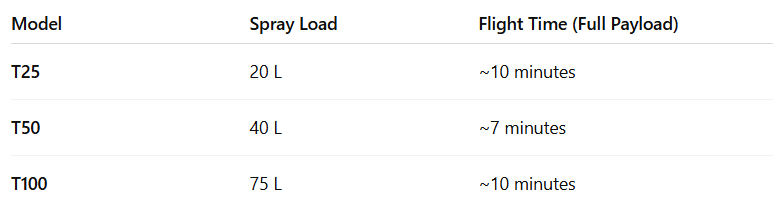
At first glance, the loaded flight times seem similar across models, but remember, the T100 is lifting nearly double the weight of a T50 and almost 4× that of a T25 in each flight).
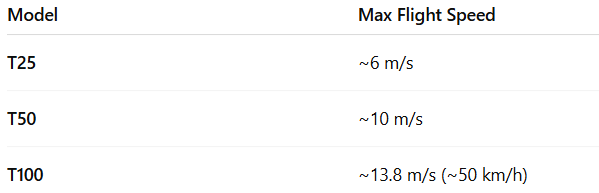
It drastically increases efficiency per sortie. From experience, our customers get to do 17-18hc per hour in maximum, with a typical operating efficiency of 12 hectares an hour. Given the T50 and T100 have a swath width of 10m, after some calculations on the expected coverage:
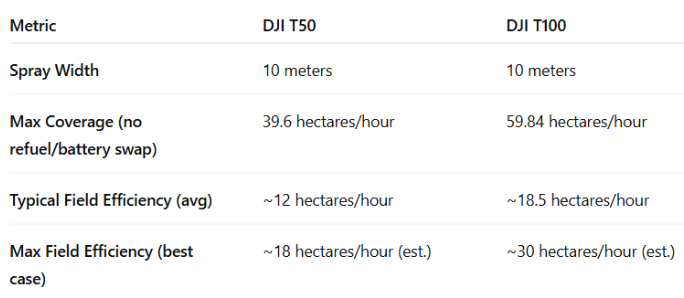
Fewer flights = fewer takeoffs, fewer refills, less battery swapping, and reduce the cumulative battery cycles and man-hours required. In a day of work, the T100 could complete 1–2 fewer flights than a T50 for the same area — and cut hours off a job compared to the T25. We estimate that a T100 could save around 20-25% in time and labor compared to using a T50 for the same workload. Over a long day, that might mean finishing a few hours earlier or covering extra fields – which lowers operating cost over time.
All three drones have similar recommended wind tolerance (around 6 m/s for safe spraying), but the T100’s heavier frame and more powerful motors provide extra stability in breezy conditions where a lighter drone might struggle. Faster and more stable flight translates into quicker job completion and the ability to operate in marginal conditions that might ground smaller drones.
Spraying Capacity
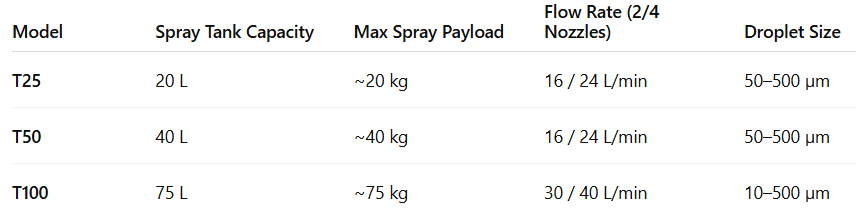
The T100 can empty its full tank in just ~2–3 minutes at max flow, allowing fast, dense applications when needed (e.g. fertilizer, frost control). You can also fine-tune spray settings for lighter, more delicate applications. It's fast and flexible.
Of course, not everyone needs that extreme capacity. If your typical jobs are small orchards or vegetable plots, a 75 L tank might be overkill (and you’re paying for capacity you won’t fully use every time). That’s why DJI still offers the T25 and T50 – they are more size-appropriate for modest needs. The T25’s 20 L tank is often enough for small farms or research plots, and its compact size makes refilling and handling very quick. The T50’s 40 L hits a sweet spot for many medium-sized farms – big enough to cut down refills significantly versus older 10–20 L drones, but not as large and heavy as the T100.
Spreading Capacity
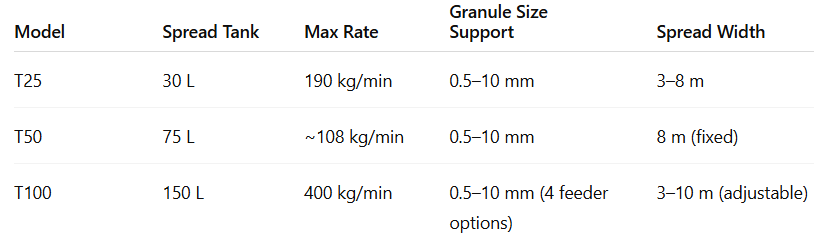
The T100’s spreader is a beast for capacity and spreading rate. It now also features an intelligent screw feeder system with 4 different attachments to handle granule sizes from fine powder up to about 10 mm without clogging. For the T50, you have no options to change the feeder. Now for the T100, you are able to swap the screw feeders, which allows you to adjust how the granule drops and changes the spread width.
By comparison, the T50’s spreader holds ~75 L and can output ~100+ kg/min, and the T25’s holds 30 L (outputting ~190 kg/min max). All can effectively spread cover crop seeds or fertilizer, but the T100 can cover vastly more area per fill and is better suited for large-scale spreading tasks.
With a faster airspeed and stronger propulsion system, it helps to push the granules better to the soil and increase efficiencies.
Heavy-Lifting Mode (T100 Only)
Unique to the T100, it has a lifting mode with a winch hook that can carry up to 85 kg of payload (via a 10 m rope).
This isn’t a feature used for crop spraying, but it opens up other possibilities on the farm – for example, hauling supplies to remote locations, ferrying irrigation equipment, or even supporting tasks like aerial firefighting with a small water bucket. Essentially, the T100 can double as an aerial crane for rural operations. We are excited to explore possible options for this new added lifting system.
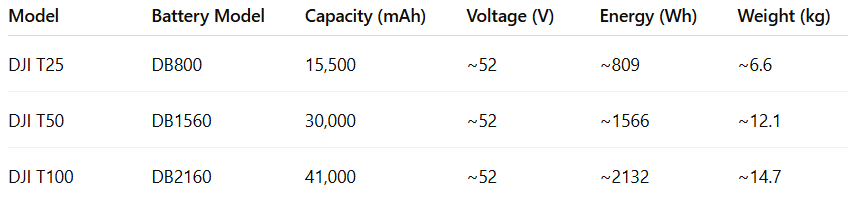
Despite the massive differences in capacity, all these battery systems are designed for rapid charging and long service life. The T100’s single battery carries roughly 1.8× the energy of the T50’s battery on its 9kW fast charger. By the time you’ve refilled the spray tank, a fresh battery can be ready to go.
Equally impressive is the battery lifespan. They are rated for up to 1,500 charge cycles with proper maintenance – far more than previous-gen drone batteries. In other words, they can be used for several seasons of heavy use before needing replacement, which significantly lowers your long-term operating costs.
Sensing and Autonomy
All three drones come with DJI’s proven Dual Active Phased Array Radar systems and binocular vision sensors. These give each drone a 360° awareness of its surroundings. In practical terms, they can detect obstacles in front of and behind the drone out to about 30 m (even in darkness or fog, since radar isn’t reliant on light). The drones will automatically brake and rise to avoid obstacles, and they also use this system for terrain following – hugging the ground contour to keep a constant height above crops, which is critical for even spray coverage.
NOW: The Agras T100 has the onboard Lidar scanner and an augmented reality (AR) display system. The sensing range has also been increased from 30m to 60m on the T100. This helps with obstacle avoidance despite the increase in flight speed. The spinning Lidar unit actively maps the environment in 3D with high precision. This means the T100 can pick up smaller or low-contrast obstacles that radar might miss – for example, thin power lines or bare branches. The Lidar data feeds into the new AR interface for the pilot: using the DJI Goggles or on the controller screen, you can actually see a live point-cloud visualization of the terrain and obstacles around the drone. They highlight power lines or obstacles (like an AR outline of a tree) and even project the drone’s planned path and landing point onto the display.
Remote controller
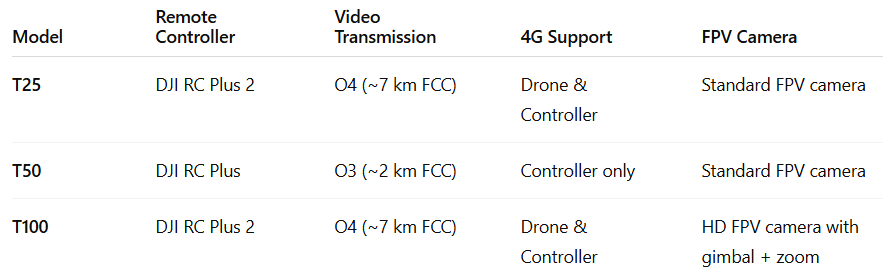
DJI has kept the user experience consistent across the T25, T50, and T100 – so if you can fly one, you can transition to the others with minimal learning curve. All three run on the DJI Agras/Pilot 2 application and support the DJI RC Plus series remote controllers (the T100 and newer T25 ship with the latest RC Plus 2, while the T50 uses the original RC Plus). The newer RC will give you better transmissions (O4).
These controllers feature a bright 7-inch screen, are weather-resistant, and have customizable buttons – perfect for outdoor use with gloves on, etc. The interface for mission planning is the same: you can draw or import field boundaries, set your spray parameters (like dosage per hectare, flight height, overlap, etc.), and the app will generate an efficient flight path automatically. One-tap takeoff and autonomous mission execution are standard on all.
Agras T25: This is the smallest and lightest, weighing about 32–33 kg with battery. It has a compact folding design that one person can carry and deploy fairly easily (it’s about the size of a large suitcase when folded). If your operations involve moving the drone between many small fields, the T25’s portability is a big plus. You can throw it in the back of a utility vehicle or pickup and set it up in minutes by yourself.
Agras T50: With a takeoff weight around 52 kg (battery in), the T50 is heftier. It also folds, but you will typically use two people to lift and carry it safely, especially with a full tank. It’s still quite portable for its capacity – fitting in a ute/trailer and deployable by a small team in the field. Many consider the T50 the largest size that’s comfortably handled without specialized equipment. It strikes a balance between size and convenience.
Agras T100: This drone is massive – roughly 73 kg with battery and empty tank. It does have folding arms to reduce its volume for transport, but make no mistake, you’ll likely need a pickup truck or trailer dedicated to hauling it, and might require two people (if not some lifting tools) to move it around. Field deployment of the T100 might involve ramps or dollies to roll it out if it’s loaded. The extra logistics are something to plan for if you go with the T100 – it’s a powerhouse, but not as grab-and-go as a T25.
Another operational aspect is support and ecosystem. All these Agras drones tie into the DJI SmartFarm platform. This means you can log your flights, generate spray reports, and even use cloud-based tools for crop management. If you’re an agronomist or large farm manager, the data captured (spray volume, area covered, flight maps) can be invaluable for your records. The T100 being the newest also integrates with any upcoming DJI farm AI features (for example, spotting crop health issues via its camera, or connecting with DJI Base Stations for centimeter-level positioning). But even the T25 and T50 benefit from this ecosystem approach – they’re not isolated gadgets, they’re part of a larger smart farming toolkit.
From our experience, many users start with what fits their current needs (maybe a T25 for a hobby farm or a T50 for a business). If you’re on the fence, consider your 2-3 year outlook: Are you taking on bigger projects or expanding your farm acreage? If so, opting for the larger model might save you from having to upgrade again so soon. On the other hand, if your work volume remains modest, the smaller models will serve you well without extra complexity.
Aside from increase in spraying and spreading efficiency, the new lifting features and safety systems is also something nice to consider as it adds a whole new purpose to the T100.
Lastly, consider redundancy and fleet composition – some large operators use multiple T50s simultaneously instead of one T100, for example, to have a backup and flexibility of splitting up for different fields. There isn’t a one-size-fits-all answer, but the good news is all three Agras drones carry DJI’s hallmark reliability and support. No matter which you choose, you’re getting a high-quality aircraft that has been tested and proven in real farming conditions worldwide.
Still not sure which drone is the perfect fit for your needs? Give us a call – we’re happy to talk through your requirements, budget, and expectations to help you make the right choice. We’ve worked with operators using all of these models and can offer insights into what will serve you best. When you’re ready, we can also provide training (Setup, RePL, Type ratings etc) and support to get you flying confidently.
DJI Agras T100: Shop page
DJI Agras T50: Shop page
DJI Agras T25: Shop page
View T100 bundles for sale - with option to reserve a kit from our first shipment
View 30 min first impressions video below
35-min video: T50 Full Spraying Demo
2-min video: Customer scouting stock yards, feral pigs and even mustering.
T30 demo, T40 demo, and T50 demo
8-min video: summary of the T50s flight modes available on controller screen
2-min video: see the high flow rate and penetration a DJI T50 can deliver
Video the T50 holding its droplets in a controlled vortex bubble over a rice plantation
Go to all our YouTube videos (demos, how-to videos, Shorts)
Get fast local quotes for contractor spraying or mapping work here
View dry-hire drone rental fleet and prices
DFH Batch Master chemical mixing stations
DFH aluminium enclosures for spray drones (2-min video)
CASA article: Drones taking agriculture sky high
AAUS: the leading association for uncrewed systems (drones, ROVs, robots) in Aus.
DJI Agriculture main site
Blackberry control action groups: Weeds Australia, VIC , NSW
Cotton Australia main site
© 2026 Drones For Hire. All rights reserved.
This article may not be reproduced, distributed, or transmitted in any form or by any means without prior written permission from the author or publisher, except in the case of brief quotations used for review or scholarly purposes.
Disclaimer: The information provided in this article is for general informational purposes only and does not constitute professional or legal advice. While efforts have been made to ensure the accuracy and relevance of the content, readers should consult with qualified experts or local authorities before making decisions related to agricultural drone use, regulations, or investments.