Last updated by Rachel N on 04/09/2025

Returning to the full service overview? Read the original DFH article:

Get Your ReOC with DFH (Drones For Hire)

1. What is the difference between a ReOC and a RePL? Why do I need a ReOC?

  • RePL (Remote Pilot Licence): A personal licence that allows you to fly drones commercially under someone else’s ReOC, or in limited excluded category operations. 

It is held by an individual and certifies that you’ve completed CASA‑approved training, including aeronautical theory, at least five hours of flight time, and a practical flight assessment.

  • ReOC (Remote Operator’s Certificate): An certificate held by business or organization (including sole traders), it is issued by CASA that allows you (or your company) to operate drones commercially, supervise other RePL holders, and expand operational capabilities via CASA approvals (e.g., EVLOS, BVLOS, night flying, restricted airspace).

👉 Simply put:
RePL = your permission to fly the drone.
ReOC = your right to operate and supervise drone operations professionally.

To dive deeper into what’s required for a RePL in 2025 and how that differs from ReOC, check out this guide: RePL: Licensing for Drone Operations in Australia (2025 Update) (Drones For Hire).


2. Do I need a Remote Pilot Licence (RePL) or Type Rating before applying for a ReOC?

Yes. You must already hold a RePL, and we strongly recommend you to hold the Type rating you want before applying for a ReOC.

  • Any Type Ratings (TRs) (e.g., DJI Agras T50/T100, heavy-lift drones) you want included on your ReOC must already be on your RePL.

  • If you add TRs later, CASA requires a ReOC Variation (Form 101-02) with additional fees and processing. (We can help with that, inquire us for the price)


3. What information and paperwork are required for a ReOC application?

To start your application, you’ll need:

  • ARN (Aviation Reference Number) and ID.

  • Entity details (individual sole trader or company/ASIC extract).

  • Ops scope (what you plan to do) and your aircraft list.

  • Completed CASA Form 101-06, DFH intake form, and supporting documents.


4. What do I need to apply for a ReOC?

In addition to the paperwork, you’ll need to:

  • Decide if you’re applying as an individual or a company.

  • Be willing to go through an interview with a CASA Delegate.

  • Prepare a mission pack (Job Safety Assessment, Risk Assessment, Flight Authorisation).

DFH provides intake forms, templates, and coaching to make this smoother. Steps to prepare a mission pack and the interview will be sent to you after enrolment.


5. How does the ReOC application process work with DFH?

Here’s the workflow:

  1. You choose Fast-Track or Lightweight package.

  2. DFH sends you an intake form + checklist.

  3. You complete CASA Form 101-06 and supply docs.

  4. DFH packages and submits to our Delegate.

  5. Delegate issues custom manual, scenario, and booking link.

  6. You complete the scenario & mission pack, and book a date for an interview with the delegate (online).

  7. Interview with Delegate → Knowledge Deficiency Report (KDR) if needed → fix & resubmit.

  8. Delegate lodges with CASA → CASA issues ReOC.


6. How long does it take to obtain a ReOC?

The exact timeframe depends on CASA’s workload and how quickly you return your documents and amendments, but with DFH’s packaging and Delegate pathway, most applicants receive their ReOC in 2–3 weeks on average. Faster turnarounds are possible if you are ready and responsive.

Typical timeline once all documents are submitted:

  • Time to first contact / pre-interview call
    As soon as we receive your registration, we send you the initial info pack. You’ll need to return two key documents from that email. Once we have everything, allow about 1 week for us to review your application and request amendments if needed.

  • Pre-interview to scenario issue
    The Delegate will send you your assessment scenario 4 days before your interview.

  • Average wait to an interview slot
    Usually 7–10 days to secure an interview with the Delegate once you’re ready.

  • From interview to CASA issue
    After your interview (and closure of any Knowledge Deficiency Report, if issued), the Delegate makes a recommendation to CASA. CASA generally issues the ReOC within 3–5 business days.

👉 Overall: If you’re organised and contact the Delegate quickly, a ReOC can typically be issued in 2–3 weeks.


7. How much does it cost to get a ReOC? What’s the difference between Fast-Track and Lightweight packages?

  • Fast-Track ($2,380): Full support, 2 × 60-min coaching calls, DFH packaging, custom Operations Manual, email support until interview, access to DFH resource kit.

  • Lightweight ($1,980): One 30-min consult, basic packaging, Delegate-provided manual, access to resource kit (ongoing 1:1 help billed separately). 

👉 Choose Fast-Track if you want speed, certainty, and coaching. Choose Lightweight if you’re confident and independent.


8. What is in the ReOC interview?

The Delegate will test your knowledge of:

  • Your Operations Manual (how your organisation runs safely) → the manual will be provided to you after enrolment.

  • Risk assessments (JSA/RA) and flight authorisation forms.

  • CASA regulatory knowledge (Part 101, airspace, safety rules).

  • Scenario-based planning (showing how you would manage a mission).


9. What is the assessment process?

  • Submit application docs → DFH/Delegate check for completeness.

  • Receive scenario + prepare mission pack.

  • Attend an interview (online or phone).

  • If gaps are found, Delegate issues a Knowledge Deficiency Report (KDR) → you address it.

  • Delegate submits documents to CASA

  • Wait for CASA approval → ReOC issued.


10. Does a ReOC need to be renewed, and what is the process?

  • An initial ReOC is valid for 12 months.

  • Renewals are then valid for up to 3 years.

  • The nominated CEO can renew the ReOC online up to 3 months before expiry, but only if there are no changes to the organisation or its operations.

Important: You cannot renew an expired ReOC. If it lapses, you must apply for a completely new certificate, pay the fees again, and complete the full application assessment.

  • Renewal involves updating your Ops Manual (if needed), ensuring personnel details are current, and resubmitting through CASA.

  • DFH offers consultancy services for renewals, Type Rating additions, area approvals, and other ReOC Variations (Form 101-02).

11. What is a change to a ReOC — CASA Form 101-02 (Variation)

CASA splits changes into significant and insignificant:

Significant Changes

You must submit these through myCASA or using the appropriate form. They typically result in a variation or re‑issue of the ReOC. Examples include:

  • New key personnel (e.g., CRP, CEO, Chief RePL Instructor),

  • Adding Type Ratings (new aircraft types),

  • Expanding operational scope (e.g., BVLOS, night ops),

  • Major revisions to your Operations Manual or safety procedures.

Use CASA Form 101‑02: “Application RPA Operators Certificate (ReOC) – initial issue/variation/renewal”
👉 [Download the form here]


Non-Significant Changes

These are minor edits that do not affect operational safety or scope. Examples include:

  • Correcting spelling or formatting errors,

  • Updating serial numbers,

  • Tweaks to scheduling or safety protocols that enhance safety,

  • Adding a new drone within the already approved scope,

These changes are non-chargeable and typically processed quickly. You can notify CASA via the myCASA portal under “Manage Certificates” → select your ReOC → “Notify CASA of a non-significant change.”
👉 [Download the form here]


👉 Ready to apply? DFH takes care of packaging, manuals, and interview prep so you can get your ReOC faster and with confidence.


Last updated by Rachel N on 18/08/2025

Previously, there has been a heated debate on whether the T100 is considered the Medium or Large RPA category. 

Globally, DJI lists Max Takeoff Weight (MTOW) up to 175–177 kg for certain T100 configs → that would be Large RPA (>150 kg). Two weeks ago, DJI limited Australian T100 operations to a maximum gross weight of 149.9 kg. Under CASR 101.022, that places the T100 in the Medium RPA category (>25 kg and ≤150 kg). 

Not just selling the T100, DFH can assist you get compliant fast: RePL, ReOC application support, arrange Type rating exams. We also provide operations setup days.

▶️ Watch on YouTube: https://www.youtube.com/watch?v=mz0rcCpcQ7g


What changed?

  • Weight & category: With operations capped at 149.9 kg MTOW, T100 use in Australia falls under Medium RPA (CASR 101.022)

  • Why that matters: Medium RPA thresholds trigger specific licensing and operational requirements (RePL upgrade - Type Rating, ReOC ops, procedures, documentation).


What you’ll likely need to operate the T100

  1. RePL + Type Rating for the T100 type
    You will need the Standard RePL first. Then a type rating assessment on the T100 is required to legally operate it. DFH is now getting our own TR on T100, we are also happy to assist our customers in arranging the exams.

  2. Operate under a ReOC with appropriate documentations
    For paid/commercial work, you’ll need a ReOC with matching scope, manuals, procedures, and risk controls. Civil Aviation Safety Authority

  3. If you already have the ReOC.

You will need to submit a ReOC significant change to CASA to include the T100 in your operation manual and library. To do it, you need to have obtained the T100 Type rating first. Give us a call if you need assistance.

Please make sure the manual, library, maintenance, RA/JSA, emergency procedures and more, everything is aligned to Medium RPA risk.


How DFH helps

  • T100 sales, commissioning & tech support

  • Authorised sales of DJI Agras T100 with options for finance and insurance referrals.

  • Setup Day (on-site or at DFH): commissioning, firmware, app setup, crew roles, weight & fill calculations (≤149.9 kg), brief on workflow, maintenance & record-keeping, and more!

  • Tech support: phone/email escalation, warranty handling, spares & repairs, firmware/update guidance, and operational troubleshooting.

  • RePL standard course & T100 type training – we can arrange training for you.

  • ReOC application support – we prepare or co-prepare compliant manuals, forms, and evidence packs, then coordinate with a CASA delegate for initial ReOC approval.

Fast-track option: Already flying T50 or other AGRAS drones? We can assist you in how to amend your current systems to Medium RPA requirements, fill the gaps, and schedule your upgrade pathway.


FAQ

  1. Is the T100 “Large RPA”?
    No. In Australia, Large RPA is >150 kg; Medium RPA is >25 kg and ≤150 kg. At 149.9 kg, T100 is Medium RPA.


  1. Can I fly the T100 under the “excluded” category?
    Most commercial work will require a ReOC and RePL (Medium).


  1. I already have a Small RPA RePL—what’s my upgrade path?
    The Part 101 MOS sets standards for upgrading from small to Medium RPA. You will need a Type rating T100 exam to obtain the rating.


  1. I already have a Medium RPA RePL (for T50 type) and a ReOC. What do I need to add to operate the T100?

You’ll need a T100 type endorsement. For the ReOC, ensure your Ops Manual explicitly includes DJI Agras T100 and related procedures Then, submit a ReOC variation (Form 101-02) with updated manual/procedures, and all related documents.
Also, register the T100 with CASA and update insurance (if applicable).


  1. Do I need new manuals?
    Yes, each Medium RPA ops has their own manuals and procedures, maintenance etc. You will need to update your current ReOC and submit it for CASA’s approval.


Get started with DFH

  • Give us a call: On the type of drones you are interested in. We will advise the documents required.

  • RePL upgrade & T100 type training: We’ll arrange your training plan, no worries.

  • ReOC application: Choose DFH-prepared manuals or co-prepared with a CASA delegate


Call 1300 029 829 today to secure your slot for the next T100 intake.


Last updated by Nick S. on 25/07/2025
Note: work suggested below needs to be performed by an electrician.

Fastest charging – use C12,000 charger (3-phase only)

Setup: C12,000 charger connected to a 3-phase min. 16kva genset (petrol or diesel). 
This Hyundai 18 Kva - 3 phases generator is recommended.

Cable setup: merge the 2x black leads that come out of the charger into 1x 32amp 3-phase plug (large round orange one), to go into the corresponding socket on the genset.


2nd Fastest charging – C10,000 charger

Setup - choose either:

a min 15kva single-phase genset (inverter pure sine wave if petrol)
or,
3-phase min 14kva genset (inverter pure sine wave if petrol)

This Hyundai 18 Kva - single phase generator is recommended.

Single-phase cable setup:
Take the 2x black leads that come out of the C10,000 charger, add a 32amp single phase plug to the end of each cable, and a  32amp single phase socket at the genset.  pics below


image.png
image.png

3-phase Cable setup:

Merge the 2x black leads that cone out of the charger into 1x 32amp single-phase plug (large round orange one), to go into corresponding 32amp single-phase socket on genset.  


image.png


Last updated by Nick S. on 16/07/2025
If you're an Australian grower or grazier considering a spray drone, you're likely weighing up the soon-to-be-released DJI Agras T100 against the proven performance of the T50. Here's a breakdown of the key factors to help guide your decision.


Purpose and Use Case

DJI T100:
Designed for large, open, and relatively flat properties (300+ ha), the T100 excels in broadacre operations. Its size, speed, and liquid capacity make it ideal for covering long, uninterrupted runs with minimal obstacles like trees or steep hills.

DJI T50:
While the T50 is also suitable for broadacre work, it's more compact and agile-making it better suited to mixed terrain including hills, paddock edges, and tighter spaces. Though it covers less ground per hour than the T100, its versatility is a strength.


Productivity and Performance
T50:
- Already available and field-proven.
- June sale pricing: $27,500 ex GST for the 3-battery bundle.
- Two T50s can cover up to 26 ha/hour combined (13 ha/hour each at 25 L/ha application rate).
- Flow rate: 24 L/min.
- Tank capacity: 40 L.
- Cruise speed: ~28 kph.

T100 (estimated):
- Not yet released; real-world performance still to be confirmed.
- Estimated coverage: ~21 ha/hour at 25 L/ha.
- Flow rate: up to 40 L/min.
- Tank capacity: 75 L.
- Likely spray speed: ~38 kph.

In theory, the T100 could be ~1.5x more productive than a single T50. However, it's still slightly less productive than two T50s combined-though simpler logistically, with just one aircraft to manage and fewer battery swaps.


Labour and Logistics
2x T50s:
- Requires 2 operators.
- More equipment to manage.
- Greater trailer space and more setup time.
- Can operate side-by-side or in different paddocks simultaneously.

T100:
- Operable by a single person.
- Bulkier, but designed to be disassembled for easier transport.
- Easier to manage day-to-day from a staffing perspective.


Reliability and Maturity
T50:
- Well-tested and reliable in Australian conditions.
- A known issue with some battery batches has now been resolved.

T100:
- Brand new platform.
- As with most new tech, expect some initial firmware issues.
- DJI generally responds quickly with updates.


Cost Comparison and ROI
Option A: Two T50s
- 2x T50 kits (3 batteries each): $55,000 ex GST
- 2x Spreaders: $4,000
- 24 kVA generator required
- Total: ~$59,000 ex GST

Option B: One T100
- T100 kit (3 batteries): ~$44,000 ex GST (expected)
- 1x Spreader: $2,000
- 16 kVA 3-phase generator required
- Total: ~$46,000 ex GST


Additional Considerations:
- The T100 will likely hold its value longer due to newer tech.
- T50s are eligible for the instant asset write-off before June 30.
- With two drones, you gain operational redundancy and more flexibility.


Final Thoughts
If you need a solution right now that is proven, versatile, and cost-effective-two T50s are a smart move, especially while EOFY deals and tax incentives are active.

If your primary goal is broadacre efficiency with simpler logistics and you're comfortable waiting (and taking a chance on a new platform), the T100 may be worth holding out for.


We hope these insights help with your decision. For tailored advice, contact the DronesForHire.com.au team on 1300 029 829 or [email protected]


Spec Comparison


Spec Comparison DJI T50 DJI T100
Max Takeoff Weight (at sea level)spraying: 92 kg
spreading: 103 kg
spraying: 148 kg (by default)
spraying: 149.9 kg (mist system)
spreading: 129.9 kg
lifting: 149.9 kg
Empty Weightspraying: 39.9 kg
spreading: 39.9 kg
spraying: 58.3 kg
spreading: 60.2 kg
lifting: 60.2 kg
Weight (with battery)Spraying: 52 kg
Spreading: 52 kg
Spraying: 73 kg
Spreading: 74.9 kg
Lifting: 64.9 kg
Dimensions (Unfolded)(mm)L:2800
W:3082
H:822
L:3200
W:3725
H:975
Dimensions (Folded)(mm)L:1115
W:750
H:900
L:1105
W:1265
H:975
Max Horizontal Speed10 m/s13.8 m/s
Motor48 rpm/V60 rpm/V
Propeller54 in (8 pairs)62 in (8 pairs)
Max Flight Time (MAX Payload, Hovering)7 min10 min
Spray Tank Volume40 L75 L
Operating Payload40 kg75 kg (2 nozzles)
73 kg (4 nozzles)
Number of Nozzles2 (rear)
4 (2 front, 2 rear)
2 (rear)
4 (4 rear) (avoid binocular affecting)
Max Spray Rate12 L/min (2 nozzles)
16 L/min (4 nozzles)
30 L/min (2 nozzles)
40 L/min (4 nozzles)
Droplet Size50–500 μm50–500 μm (2 nozzles)
100–500 μm (4 nozzles)
Swath Width4–11 m5–11 m
Spreader Tank Volume75 L150 L
Spreader TypeSpiral Channel Spinning DiskCentrifugal Throw Plate, Screw Feeder (anti-clog)
Load Capacity50 kg75 kg
Max Spread Rate108 kg/min400 kg/min
Granule Material Diameter0.5–5 mm • Super Large Screw Feeder: 0.5–10 mm
• Medium Screw Feeder: 4–6 mm
• Large Screw Feeder: 4–10 mm (optional)
• Small Screw Feeder: 0.5–4 mm (optional)
Spread Width8 m (fixed)3–10 m (adjustable)
Payload CapacityN/Aup to 85 kg
Length of lifting ropeN/Alifting rope: 10 m
Sensing Range30 m (≤10 m/s)60 m (≤13.8 m/s)
Phased Array Radar Systemyesyes
Binocular Vision Systemyesyes
Lidar Sensing Systemnoyes
AR featureNo• Point Cloud real-time display
• People/Vehicle obstacle AR display
• AI Route
• RTH AR shade
RCDJI RC PlusDJI RC Plus 2
Video TransmissionO3O4
4G EnhancedController OnlyController & Aircraft Supported
Battery ModelDB1560DB2100
Weight12.1 kg14.7 kg
Capacity30000 mAh41000 mAh
Energy1566.6 Wh2132 Wh
Energy Density129.47 Wh/kg145.03 Wh/kg
ChargerC8000C10000
Weight (Charger)11.5 kg11.4 kg
Input Power (single phase)Main: 230 VAC, 50 Hz, 15 A MAX
Auxiliary: 230 VAC, 50 Hz, 15 A MAX
Main: 230 VAC, 50 Hz, 24 A MAX
Auxiliary: 230 VAC, 50 Hz, 24 A MAX
Output Power6000 W9000 W
Charging Time (20–95%)11–12 mins10–11 mins

Charging and Battery Comparison

Feature C8000 C10000
Charging Time C8000 (by default)
C10000
C10000
C12000 (by default)
Battery DB1560 (30000 mAh)
weight: 12.1kg
capacity-to-density ratio: 129Wh/kg
DB2160 (41000 mAh)
14.7kg
145Wh/kg


View T100 bundles for sale - with option to reserve a kit from our first shipment

View 30 min first impressions video below


Last updated by Nick S. on 15/07/2025

For broadacre work, we speculate (we don’t have our first unit yet as at the time of writing – 15/7/25), that the DJI T100 will cover up to 26 ha of crops like cotton per hour  (at 20L per ha application rate (one drone).


For spot spraying, compared to a quick spray, you should expect to be roughly 3x as efficient and be using 20%-60% less chemical to get the same kill rate (spray drones are famous for their efficacy because they have the advantage of their big rotors pushing droplets  down, and circulating them throughout the target.


If you are an existing spray drone operator , operating a T50 or T40, you may perceive the T100 as a very big machine, designed just for large broadacre properties – this is not necessarily the case – the T100 has a new lidar sensory system which will enable it to much more confidently move around tricky country – steep, rocky sections, gullies, trees surprisingly well for a relatively big fella! This lidar system will also, in some cases,  negate the need to pre map the operating area  – because the aircraft is more capable of sensing its surrounding environment on the fly and making more confident (less hesitation ) manoeuvres as a result.


Let’s say you’re doing 500 ha a day with your SP sprayer. You might only need 2x or at most 3x T00 drones to do the same, but it’s important to note an SP sprayer costs about 20x as much ($800k or more), requires a lot more maintenance, and can’t operate on soft (wet) ground. So whilst a T100 is not an SP sprayer, it punches way above its weight considering its size, cost, and versatility. Not to mention its modular design, uncomplicated maintenance program, low cost of parts, no diesel expense, and much more efficient use of inputs.


Keep in mind, operating one or more spray drones requires battery changes and liquid/granular refills as a steady workflow as you’re going. You’re not sitting in the cab of an SP sprayer – rather,  your running an ag drone pit crew!


View T100 bundles for sale - with option to reserve a kit from our first shipment

View 30 min first impressions video below


Last updated by Nick S. on 15/07/2025


DJI holds a dominant position in the drone market, especially within the agricultural sector where it commands a global market share of approximately 30-34% of agricultural drone revenue. This dominance extends to the overall civil drone market, with an impressive 70-90% share. By the end of 2024, DJI is projected to have deployed around 400,000 agricultural drones globally. The company's agricultural division alone generates an estimated US$1.2-1.5 billion annually in revenue. DJI is a privately held company with substantial funding, reporting $3.8 billion in revenue in 2021 and employing around 14,000 people. Its global reach is extensive, operating in over 100 countries with a strong presence across Asia, North America, Europe, and Latin America, providing robust support and service to its vast customer base.


View T100 bundles for sale - with option to reserve a kit from our first shipment

View 30 min first impressions video below


Last updated by Nick S. on 15/07/2025

Aircraft

  • Weight

  • Weight for spraying: 75 kg (standard with 2 nozzles)
    Weight for spraying: 77 kg (optional with 4 nozzles)
    Weight for spreading: 75 kg (equipped with spreading system)
    Weight for lifting: 65 kg (equipped with lifting system)
    Weight for lifting: 90 kg (equipped with dual-battery lifting system)
  • Max Takeoff Weight[1]

  • Max takeoff weight for spraying: 175 kg (standard with 2 nozzles)
    Max takeoff weight for spraying: 177 kg (optional with 4 nozzles)
    Max takeoff weight for spreading: 175 kg (equipped with spreading system)
    Max takeoff weight for lifting: 165 kg (equipped with lifting system)
    Max takeoff weight for lifting: 170 kg (equipped with dual-battery lifting system)
  • Max Diagonal Wheelbase

  • 2330 mm (diagonal)
  • Dimensions

  • 3220 mm × 3224 mm × 975 mm(arms and propellers unfolded)
    1820 mm × 1840 mm × 975 mm(arms unfolded and propellers folded)
    1105 mm × 1265 mm × 975 mm(arms and propellers folded)
  • Hovering Accuracy Range (with strong GNSS signal)

  • RTK Enabled:
    ±10 cm (horizontal), ±10 cm (vertical)
    RTK not enabled:
    Horizontal ± 0.6 m, vertical ± 0.3 m
  • Max Configurable Flight Radius

  • 2 km
  • Operating Temperature

  • 0 °C to 40 °C
  • Max Wind Resistance

  • <6 m/s

Propulsion System - Motors

  • Stator Size

  • 155 × 16 mm
  • KV

  • 60 rpm/V

Propulsion System - Propellers

  • Material

  • Carbon Fiber Composite
  • Dimensions

  • 62 inches
  • Quantity

  • 8 pairs

Spraying System

  • Model

  • LS100
  • Dimensions

  • 880 mm × 870 mm × 810 mm (spray rod folded)
    1020 mm × 1930 mm × 810 mm (spray rod unfolded)

Spraying System - Spray Tank

  • Material

  • HDPE
  • Volume

  • 100 L
  • Operating Payload[1]

  • 100 kg

Spraying System - Sprinklers

  • Model

  • LX07550SX (Standard Nozzle) / LX09550SX (Optional Mist Nozzle)
  • Quantity

  • 2 (Standard) / 4 (Optional)
  • Nozzle Distance

  • 1834 mm (Two Nozzles / Four Nozzles Outermost)
  • Droplet Size

  • 50 - 500 μm
  • Effective Spray Width[2]

  • 5 - 11 m

Spraying system - Delivery Pumps

  • Type

  • Impeller Pump (Magnetic Drive)
  • Quantity

  • 2
  • Max Flow Rate

  • 30 L/min (Standard 2 nozzles), 40 L/min (Optional 4 nozzles)

Spreading Load

  • Dimensions

  • 900 mm × 820 mm × 920 mm
  • Compatible Material Diameter

  • Standard configuration:
    Extra-large auger: 0.5 mm - 10 mm granules (fertilizer, wheat, feed, etc.)
    Medium auger: 4 mm - 6 mm granules (rice)
    Optional:
    Large auger: 4 mm - 10 mm granules (rice, fertilizer)
    Small auger: 0.5 mm - 4 mm granules (rapeseed, granular herbicides, granular insecticides)

Spreading System 4.0

  • Spreading Tank Volume

  • 150 L
  • Spreader structure type

  • Centrifugal Disc
  • Discharge Structure Type

  • Screw Feeder Feeding
  • Max Discharge Rate

  • 400 kg/min (compound fertilizer)
  • Max load inside the spreading operation box

  • 100 kg
  • Effective spreading width[3]

  • 3 - 10 m

400 kg/min (compound fertilizer)

  • Dimensions

  • Standard payload: 805 mm × 764 mm × 669 mm

Lifting System

  • Load capacity[4]

  • 100 kg
  • Lifting Cable Length

  • 10 m (standard configuration)
  • Recommended cable length

  • 10 - 15 m
  • Operating Temperature

  • 0 °C to 40 °C

Dual Battery Lifting System

  • Dimensions

  • 805 mm × 960 mm × 669 mm
  • Load capacity[4]

  • 80 kg
  • Lifting Cable Length

  • 10 m (standard configuration)
  • Emergency Escape Mode

  • Cable Fuse Disconnection and Escape
  • Recommended cable length

  • 10 - 15 m
  • Operating Temperature

  • 0 °C to 40 °C

Safety System 3.0

  • Millimeter wave radar EIRP

  • < 20 dBm (NCC / MIC / KC / CE / FCC)
  • Operating Temperature

  • 0 °C to 40 °C
  • Operating environment requirements

  • Adequate light and discernible surroundings
  • Field of View (FOV)

  • Laser radar: Vertical 272°, Horizontal 60°
    Front Radar: Horizontal 360°, Vertical ± 45°
    Downward Radar: Left and Right ± 12.5°, Front and Back ± 22.5°
    Rear Radar: Left and Right ± 45°, Front and Back ± 45°
    Quad vision system: Horizontal 360°, Vertical 180°
    FPV camera: Horizontal ± 86°, Vertical 108°
  • Measurement range[4]

  • ≤ 60 m
  • Effective safe obstacle avoidance speed[5]

  • ≤ 13.8 m/s
  • Effective Obstacle Avoidance Height

  • ≥ 1.5 m

Remote Controller

  • Model

  • TKPL 2
  • Screen

  • 7-inch LCD touchscreen; resolution: 1920 × 1200; brightness: 1400 cd/m²
  • Storage Temperature Range

  • Less than one month: -30° to 45° C (-22° to 113° F)
    One to three months: -30° to 35° C (-22° to 95° F)
    Three months to one year: -30° to 30° C (-22° to 86° F)
  • Charging Temperature

  • 5° to 40° C (41° to 104° F)
  • Internal Battery Runtime

  • 3.8 hours
  • External Battery Runtime

  • 3.2 hours
  • Charging Type

  • Use a USB-C fast charger with a maximum power of 65 W (maximum voltage 20 V), and it is recommended to use the DJI Portable Charger.
  • Charging Time

  • 2 hours for internal battery or internal and external battery (when remote controller is powered off and using a standard DJI charger)

DB2160 Intelligent Flight Battery

  • Weight[1]

  • 14.7 ± 0.3 kg
  • Capacity

  • 41000 mAh
  • Nominal Voltage

  • 52 V

D14000iE Multifunctional Inverter Generator

  • Output Channels

  • 1. DC recharge output 42 - 61.6 V/11500 W
    2. Air-cooled radiator charge 12 V/6 A
    3. AC output 220 V/1500 W
  • Recharge Time[6]

  • 8 - 9 minutes (DB2160 Intelligent Flight Battery, 30% - 95% charge)
  • Fuel tank capacity

  • 30 L
  • Starting Method

  • Starting the Generator via the One-Button Start Switch
  • Operating Temperature

  • 0 °C to 40 °C
  • Compatible Battery

  • DB2100 / DB1580 / DB2160 Intelligent Flight Battery
  • Dimensions

  • 757 mm × 704 mm × 677 mm
  • Weight

  • 87 ± 0.5 kg
  • Fuel type

  • Unleaded gasoline with RON ≥91 (AKI ≥87) and alcohol content less than 10%
    (*Brazil: unleaded gasoline with RON ≥ 91 and alcohol content of 27%)
  • Reference fuel consumption

  • 500 mL/kWh
  • Engine Oil Capacity

  • 1.3 L
  • Engine Oil Model

  • SJ 10W-40

C12000 Smart Charger

  • Charger Model

  • CSX901-12000
  • Dimensions

  • 456 mm × 291 mm × 107 mm
  • Weight[1]

  • 13.13 kg
  • Input Voltage

  • Three-phase AC input: 175 - 520 V
    Single-phase AC input: 200 - 264 V
  • Output Voltage

  • 62 V
  • Rated output current

  • 194 A
  • Rated Power

  • 12000 W (three-phase 380 V input) 3000 W (single-phase 220 V input)
  • Recharge Time[6]

  • 8 - 9 minutes (DB2160 Intelligent Flight Battery, 30% - 95% charge)
  • Protection functions

  • Over-temperature, over-voltage, under-voltage, short circuit, fan stall, and other protection functions
  • Operating Temperature

  • 0° to 40° C
  • Output Channels

  • 1
  • Compatible with Intelligent Flight Battery

  • DB1580 / DB2160 Intelligent Flight Battery

Relay

  • Dimensions

  • 112 mm × 112 mm × 51 mm (None Antenna)
    120 mm × 112 mm × 101 mm (with antenna)
  • Weight[1]

  • 630 g
  • Input

  • 2.7 V - 24 V
  • Power consumption

  • 10.48 W (FCC), 8.8 W (SRRC)
  • Battery capacity

  • 6500 mAh
  • Operating Time

  • 5 hours
  • Operating Frequency

  • 2.4000 - 2.4835 GHz, 5.150 - 5.250 GHz, 5.725 - 5.850 GHz
  • Effective signal range

  • 5 km (SRRC), 4 km (MIC/KCC/CE), 8 km (FCC)
    (In an interference-free, unobstructed environment, flight altitude 2.5 m)
  • Charging Time

  • 2.5 hours (30W recharge)
  • Ingress Protection Rating

  • IP55

D-RTK 3 AG

  • Supports satellite systems

  • GPS: L1/L2/L5
    BeiDou: B1I/B2I/B3I/B1C/B2A/B2B
    Galileo: E1/E5a/E5b/E6
    GLONASS: G1/G2
    QZSS: L1CA/L2C/L5
    L-BAND
  • Dimensions

  • 345 mm × 244 mm × 300 mm
  • Weight[1]

  • 3.77 kg (including packaging)
  • Power consumption

  • 7 W
  • Battery capacity

  • 6500 mAh
  • Operating Time

  • 7 hours
  • Operating Frequency

  • Broadcast Mode: O4: 2.4G/5.8G
    Relay Mode: Not Supported
  • Effective signal range

  • FCC: 15 km
    SRRC: 12 km
    CE/JP: 8 km
  • Charging Time

  • 2.5 hours (30W recharge)
  • Ingress Protection Rating

  • IP67
  • Positioning Accuracy[7]

  • PPP Satellite-Based Service Accuracy:
    Convergence Time: 20 mins
    Horizontal: 30 cm (RMS)
    Elevation: 40 cm (RMS)
    Network RTK Calibration:
    Horizontal: 0.8 cm + 1 ppm (RMS)
    Vertical: 1.5 cm + 1 ppm (RMS)
    1 ppm: Accuracy decreases by 1 mm for every 1 km increase in distance between the aircraft and the base station. For example, if the aircraft is 1 km away from the base station, the accuracy is 1.1 cm.

Footnotes

  • [1] Measured at sea level, the DJI Agriculture App will intelligently recommend the loading weight based on the current aircraft status, environmental conditions, and operational tasks. Users should not exceed the recommended maximum loading weight, as it may affect flight safety.
    [2] The effective spray width of the spraying system depends on the actual working scene.
    [3] Working height is 3 m, disc rotation speed is 1100 rpm, uniformity requirement (CV<30%) measured broadcast width is 10 m. The faster the disc rotation speed, the higher the flight altitude, the larger the broadcast width.
    [4] Includes the weight of ropes and hooks. Measured at sea level, the DJI Agriculture App will intelligently recommend the loading weight based on the current state of the aircraft, environmental conditions, and operational tasks. The maximum weight of the loaded material should not exceed the recommended value, as it may affect flight safety.
    [5] The effective working range of sensing distance, obstacle avoidance, and bypassing capabilities may vary due to different environmental lighting, rain, fog, and the material, location, and shape of the subject object. The downward sensing is used to assist in terrain-following altitude flight, while sensing in other directions is used for obstacle avoidance. Except for scenes without linear obstacles, if a collision occurs at speeds up to 13.8 m/s resulting in aircraft damage, responsibility can be determined through log analysis, and the aircraft may be eligible for free warranty if non-human causes are identified. If there are linear obstacles like wires or guy wires on power poles, please mark them as obstacles; otherwise, failure to bypass them will be the customer's responsibility.
    Note: 1. The downward perception is used to assist terrain-following altitude flight. If a collision with an obstacle occurs below, it is considered the customer's responsibility. 2. Due to the performance limitations of the safety system, the aircraft cannot actively avoid moving objects. Accidents in such scenes are considered the customer's responsibility.
    [6] Sea level height, environmental temperature between 15-40 degrees Celsius, time to charge the battery from 30% to 95%; fast charging is supported when the battery cell temperature is within the range of 15-75 degrees Celsius; charging time varies depending on input power, ASL, initial charge level, and other factors.
    [7] Positioning accuracy and reliability are affected by various factors, including equipment tilt, signal obstruction, multipath, number of satellites, geometric distribution, and atmospheric conditions. It is recommended to set up the equipment in open scenes, away from electromagnetic interference and multipath environments.


View T100 bundles for sale - with option to reserve a kit from our first shipment

View 30 min first impressions video below


Last updated by Nick S. on 15/07/2025

As of 17/7/25, official pricing for Australia is $40,900.0 for the standard 3-battery kit. With the spreader adding $2735.0.  Figures are ex GST.


The T100 will be released to the market / available to purchase in the Australian market in August 2025.


Drones For Hire , as the leading ag. dealer and ag. service center, will be amongst the first in the country to receive stock and begin demonstrations nationwide.


View T100 bundles for sale - with option to reserve a kit from our first shipment

View 30 min first impressions video below


Last updated by Nick S. on 15/07/2025

Spec ComparisonDJI T100DJI T50
Aircraft
Max Takeoff Weight
(at sea level)
spraying: 148 kg (by default)
spraying: 149.9 kg (mist sytem)
spreading: 149.9 kg
lifting: 149.9 kg
spraying: 92 kg
spreading: 103 kg
Empty WeightSpraying: 58.3kg
Spreading: 60.2kg
Lifting: 50.2kg
Spraying: 39.9kg
Spreading: 39.9kg
Weight
(with battery)
Spraying: 73kg
Spreading: 74.9kg
Lifting:64.9
Spraying: 52kg
Spreading: 52kg
Dimensions
(Unfolded)(mm)
L:3200
W:3224
H:975
L:2800
W:3082
H:820
Dimensions
(Folded)(mm)
L:1105
W:1265
H:975
L:1115
W:750
H:900
Max Horizontal Speed13.8m/s10m/s
Propulsion
Motor60rpm/V48rpm/V
Propeller62 in (8 pairs)54 in (8 pairs)
Spraying
Max Flight Time
(MAX Payload, Hovering)
10min7min
Spray Tank Volume75L40L
Operating Payload75kg(2 nozzles)
73kg(4 nozzles)
40kg
Number of Nozzles2(2 rear)
4(4 rear)(avoid binocular affecting)
2(2 rear)
4(2 front, 2 rear)
Max Spray Rate30L/min (2 nozzles)
40L/min (4 nozzles)
12L/min(2 nozzles)
16L/min (4 nozzles)
Droplet Size50-500 um(2 nozzles)
10-500 um(4 nozzles)
50-500 um
Swath Width5-11m4-11m
coverageAv= 18.5 Max = 30 ha/hrAv = 12 ha/hr Max 18 ha/hr
Spreading
Spreader Tank Volume150L75L
Spreader TypeCentrifugal Throw Plate, Screw Feeder(anti-clog)Spiral Channel Spinning Disk
Load Capacity75kg50kg
Max Spread Rate400kg/min108kg/min
Granule Material DiameterSuper Large Screw Feeder:0.5-10 mm
Midium Screw Feeder: 4-6 mm
Large Screw Feeder: 4-10 mm (optional)
Small Screw Feeder: 0.5-4 mm (optional)
0.5-5 mm
Spread Width3-10m(adjustable)8m(fixed)
Lifting
Payload Capacityup to 85kgN/A
Length of lifting ropelifting Rope: 10mN/A
Safety System
Sensing Range60m(<= 13.8 m/s)30m(≤10 m/s)
Phased Array Radar Systemyesyes
Binocular Vision Systemyesyes
Lidar Sensing SystemYesNo
AR featurePoint Cloud real-time display
People/Vehicle obstacle AR display
AR Route
RTH AR shade
No
Transmission System
RCDJI RC Plus 2DJI RC Plus
video transmissionO4O3
4G EnhancedController & Aircraft SupportedController Only
Batteries
ModelDB2160DB1560
Weight14.7kg12.1kg
Capacity41000 mAh30000 mAh
Energy2132Wh1566.6Wh
Energy Density145.03Wh/kg129.47Wh/kg
Charger
ModelC10000C8000
Weight11.4kg11.5kg
Input Power(single phased)Main: 230 VAC, 50 Hz, 24 A MAX
Auxiliary: 230 VAC, 50 Hz, 24 A MAX
Main: 230 VAC, 50 Hz, 15 A MAX
Auxiliary: 230 VAC, 50 Hz, 15 A MAX
Output Power9000w6000w
Charing Time(20-95%)10-11mins11-12mins


Last updated by Rachel N. on 15/07/2025
DJI T25 vs T50 vs T100

The DJI Agras T100 was released recently.

Check our Shop page for the T100!

We’ll dive into a head-to-head comparison of the T25, T50, and the new T100 to see how they stack up and help you decide which drone fits your farming needs best.

We will also have a latest video with Nick and Oscar discussing the new coming T100. Coming soon


Flight Time, Speed & Payload

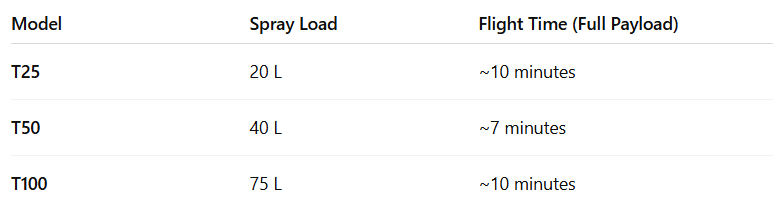
When it comes to agricultural drones, efficiency isn't just about how long they can fly — it's about how much ground they can cover in each flight.

At first glance, the loaded flight times seem similar across models, but remember, the T100 is lifting nearly double the weight of a T50 and almost that of a T25 in each flight). 

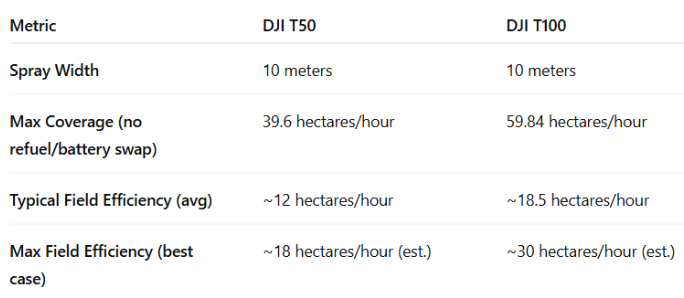
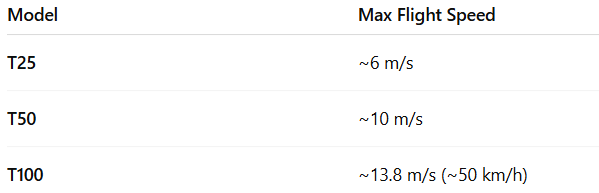
It drastically increases efficiency per sortie. From experience, our customers get to do 17-18hc per hour in maximum, with a typical operating efficiency of 12 hectares an hour. Given the T50 and T100 have a swath width of 10m, after some calculations on the expected coverage:

Fewer flights = fewer takeoffs, fewer refills, less battery swapping, and reduce the cumulative battery cycles and man-hours required. In a day of work, the T100 could complete 1–2 fewer flights than a T50 for the same area — and cut hours off a job compared to the T25. We estimate that a T100 could save around 20-25% in time and labor compared to using a T50 for the same workload. Over a long day, that might mean finishing a few hours earlier or covering extra fields – which lowers operating cost over time.

All three drones have similar recommended wind tolerance (around 6 m/s for safe spraying), but the T100’s heavier frame and more powerful motors provide extra stability in breezy conditions where a lighter drone might struggle. Faster and more stable flight translates into quicker job completion and the ability to operate in marginal conditions that might ground smaller drones.


Spraying Capacity

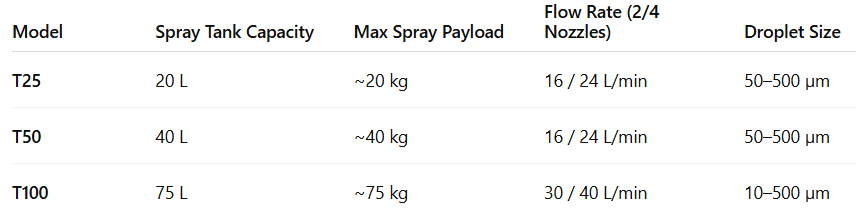
The T100 can empty its full tank in just ~2–3 minutes at max flow, allowing fast, dense applications when needed (e.g. fertilizer, frost control). You can also fine-tune spray settings for lighter, more delicate applications. It's fast and flexible.


Of course, not everyone needs that extreme capacity. If your typical jobs are small orchards or vegetable plots, a 75 L tank might be overkill (and you’re paying for capacity you won’t fully use every time). That’s why DJI still offers the T25 and T50 – they are more size-appropriate for modest needs. The T25’s 20 L tank is often enough for small farms or research plots, and its compact size makes refilling and handling very quick. The T50’s 40 L hits a sweet spot for many medium-sized farms – big enough to cut down refills significantly versus older 10–20 L drones, but not as large and heavy as the T100.


Spreading Capacity

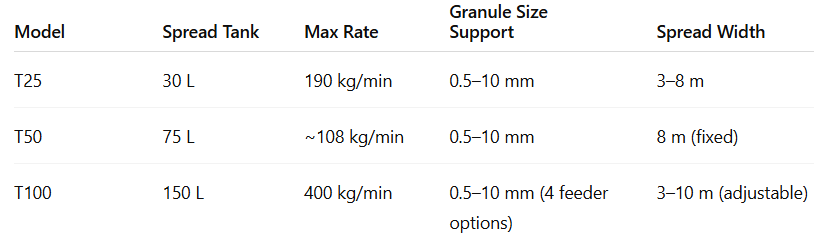
The T100’s spreader is a beast for capacity and spreading rate. It now also features an intelligent screw feeder system with 4 different attachments to handle granule sizes from fine powder up to about 10 mm without clogging. For the T50, you have no options to change the feeder. Now for the T100, you are able to swap the screw feeders, which allows you to adjust how the granule drops and changes the spread width.

By comparison, the T50’s spreader holds ~75 L and can output ~100+ kg/min, and the T25’s holds 30 L (outputting ~190 kg/min max). All can effectively spread cover crop seeds or fertilizer, but the T100 can cover vastly more area per fill and is better suited for large-scale spreading tasks.

With a faster airspeed and stronger propulsion system, it helps to push the granules better to the soil and increase efficiencies.


Heavy-Lifting Mode (T100 Only)

Unique to the T100, it has a lifting mode with a winch hook that can carry up to 85 kg of payload (via a 10 m rope). 

This isn’t a feature used for crop spraying, but it opens up other possibilities on the farm – for example, hauling supplies to remote locations, ferrying irrigation equipment, or even supporting tasks like aerial firefighting with a small water bucket. Essentially, the T100 can double as an aerial crane for rural operations. We are excited to explore possible options for this new added lifting system.

Power and Battery Efficiency: Maximizing Uptime


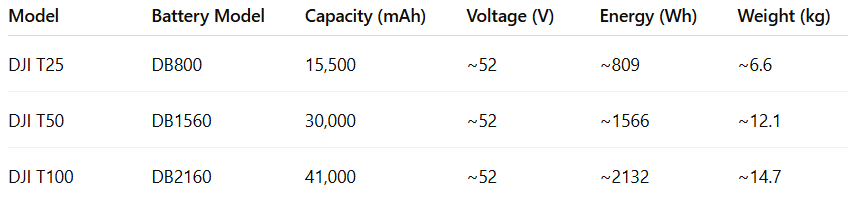
Despite the massive differences in capacity, all these battery systems are designed for rapid charging and long service life. The T100’s single battery carries roughly 1.8× the energy of the T50’s battery on its 9kW fast charger. By the time you’ve refilled the spray tank, a fresh battery can be ready to go.

Equally impressive is the battery lifespan. They are rated for up to 1,500 charge cycles with proper maintenance – far more than previous-gen drone batteries. In other words, they can be used for several seasons of heavy use before needing replacement, which significantly lowers your long-term operating costs.


Sensing and Autonomy

All three drones come with DJI’s proven Dual Active Phased Array Radar systems and binocular vision sensors. These give each drone a 360° awareness of its surroundings. In practical terms, they can detect obstacles in front of and behind the drone out to about 30 m (even in darkness or fog, since radar isn’t reliant on light). The drones will automatically brake and rise to avoid obstacles, and they also use this system for terrain following – hugging the ground contour to keep a constant height above crops, which is critical for even spray coverage. 


NOW: The Agras T100 has the onboard Lidar scanner and an augmented reality (AR) display system. The sensing range has also been increased from 30m to 60m on the T100. This helps with obstacle avoidance despite the increase in flight speed.  The spinning Lidar unit actively maps the environment in 3D with high precision. This means the T100 can pick up smaller or low-contrast obstacles that radar might miss – for example, thin power lines or bare branches. The Lidar data feeds into the new AR interface for the pilot: using the DJI Goggles or on the controller screen, you can actually see a live point-cloud visualization of the terrain and obstacles around the drone. They highlight power lines or obstacles (like an AR outline of a tree) and even project the drone’s planned path and landing point onto the display.


Remote controller

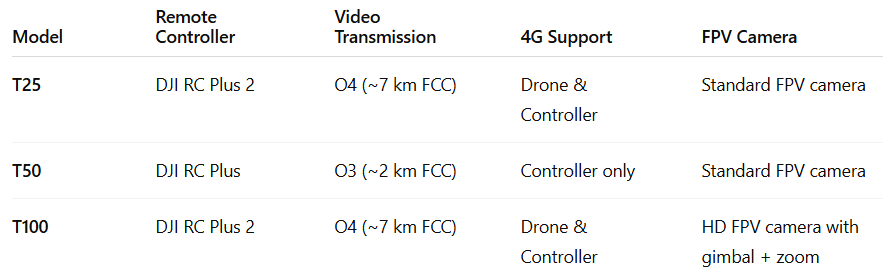
DJI has kept the user experience consistent across the T25, T50, and T100 – so if you can fly one, you can transition to the others with minimal learning curve. All three run on the DJI Agras/Pilot 2 application and support the DJI RC Plus series remote controllers (the T100 and newer T25 ship with the latest RC Plus 2, while the T50 uses the original RC Plus). The newer RC will give you better transmissions (O4).

These controllers feature a bright 7-inch screen, are weather-resistant, and have customizable buttons – perfect for outdoor use with gloves on, etc. The interface for mission planning is the same: you can draw or import field boundaries, set your spray parameters (like dosage per hectare, flight height, overlap, etc.), and the app will generate an efficient flight path automatically. One-tap takeoff and autonomous mission execution are standard on all.


Physical handling and transport
  • Agras T25: This is the smallest and lightest, weighing about 32–33 kg with battery. It has a compact folding design that one person can carry and deploy fairly easily (it’s about the size of a large suitcase when folded). If your operations involve moving the drone between many small fields, the T25’s portability is a big plus. You can throw it in the back of a utility vehicle or pickup and set it up in minutes by yourself.

  • Agras T50: With a takeoff weight around 52 kg (battery in), the T50 is heftier. It also folds, but you will typically use two people to lift and carry it safely, especially with a full tank. It’s still quite portable for its capacity – fitting in a ute/trailer and deployable by a small team in the field. Many consider the T50 the largest size that’s comfortably handled without specialized equipment. It strikes a balance between size and convenience.

  • Agras T100: This drone is massive – roughly 73 kg with battery and empty tank. It does have folding arms to reduce its volume for transport, but make no mistake, you’ll likely need a pickup truck or trailer dedicated to hauling it, and might require two people (if not some lifting tools) to move it around. Field deployment of the T100 might involve ramps or dollies to roll it out if it’s loaded. The extra logistics are something to plan for if you go with the T100 – it’s a powerhouse, but not as grab-and-go as a T25.

Another operational aspect is support and ecosystem. All these Agras drones tie into the DJI SmartFarm platform. This means you can log your flights, generate spray reports, and even use cloud-based tools for crop management. If you’re an agronomist or large farm manager, the data captured (spray volume, area covered, flight maps) can be invaluable for your records. The T100 being the newest also integrates with any upcoming DJI farm AI features (for example, spotting crop health issues via its camera, or connecting with DJI Base Stations for centimeter-level positioning). But even the T25 and T50 benefit from this ecosystem approach – they’re not isolated gadgets, they’re part of a larger smart farming toolkit.


Which Drone Should You Choose?


From our experience, many users start with what fits their current needs (maybe a T25 for a hobby farm or a T50 for a business). If you’re on the fence, consider your 2-3 year outlook: Are you taking on bigger projects or expanding your farm acreage? If so, opting for the larger model might save you from having to upgrade again so soon. On the other hand, if your work volume remains modest, the smaller models will serve you well without extra complexity.

Aside from increase in spraying and spreading efficiency, the new lifting features and safety systems is also something nice to consider as it adds a whole new purpose to the T100.

Lastly, consider redundancy and fleet composition – some large operators use multiple T50s simultaneously instead of one T100, for example, to have a backup and flexibility of splitting up for different fields. There isn’t a one-size-fits-all answer, but the good news is all three Agras drones carry DJI’s hallmark reliability and support. No matter which you choose, you’re getting a high-quality aircraft that has been tested and proven in real farming conditions worldwide.


Still not sure which drone is the perfect fit for your needs? Give us a call – we’re happy to talk through your requirements, budget, and expectations to help you make the right choice. We’ve worked with operators using all of these models and can offer insights into what will serve you best. When you’re ready, we can also provide training (Setup, RePL, Type ratings etc) and support to get you flying confidently.

DJI Agras T100: Shop page
DJI Agras T50: Shop page
DJI Agras T25: Shop page


View T100 bundles for sale - with option to reserve a kit from our first shipment

View 30 min first impressions video below