Last updated by Rachel N on 27/06/2025

DJI M400 vs M300/350 vs M600Pro

The DJI Matrice 400 (M400) was launched a few days ago on 10 June 2025 worldwide!

In this article, instead of discussing its general specs and features which are already available over the net:

To check for basic specs/ features of the M400, please check here.


When DJI released the M400, it wasn’t just about replacing the M300/600s, it was a rethink of what an enterprise drone could do. Everyone is discussing its capabilities compared to the M300/350 and M600, let’s see the differences and check out which suits you more!


We will cover different aspects including the flight performance, battery systems and implications, the payload capability and also real-world operational impacts! We will delve into specific technical comparisons, use cases, and real-life figures between the M400 and the comparable models.


Flight Time and Speed: Do More in a Single Launch

Endurance is everything when we are covering a paddock, inspecting power lines, or mapping remote bushland. The M400 flies up to 59 minutes with typical payloads like the H30T, compared to:

  • M300/350: ~40 mins (with H30T)

  • M600 Pro: ~20–25 mins (with 6 kg payload)
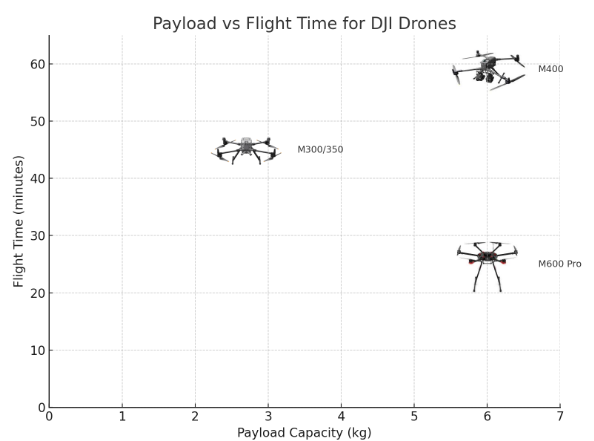
That’s 30–40% more usable airtime per flight compared to the M300/350, and double that of the M600 Pro. You don’t just get longer flights. In operation, you can do fewer takeoffs, fewer swaps, and fewer gaps in your data.


Whether it’s wind resistance or mission timing, the M400 leads:

  • Max speed: 25 m/s (90 km/h)

  • Wind tolerance: 12–15 m/s

That’s not just numbers. Faster and more stable flights translate into cleaner mapping grids, quicker job completion, and the ability to fly in more marginal conditions.


Power and Battery Efficiency

The M400 shifts from the dual-battery TB60/65 system to a single TB100 battery.

Matrice 300/350 dual-battery system (two TB60/65): 

  • TB60 is 5935 mAh, ~52.8 V, ~274 Wh (~200 charge cycles)

  • TB65 is 5880 mAh, 44.76 V, 263, smaller battery capacity but can handle ~400 charge cycles, double lifespan of TB60.

  • Redundancy and hot swapping

Matrice 600 6-battery system (6 TB47s): 

  • TB47s is 4500 mAh, ~22.2 V, ~99.9 Wh (~200 charge cycles)

M400 single large battery (TB100/100c)

  • T100 is 20,254 mAh, 48 V, ~977 Wh (~400 charge cycles ), 

  • roughly 1.8× the total energy of a pair of TB60s. 

  • That’s why longer flight times. Also rated for ~400 charge cycles 
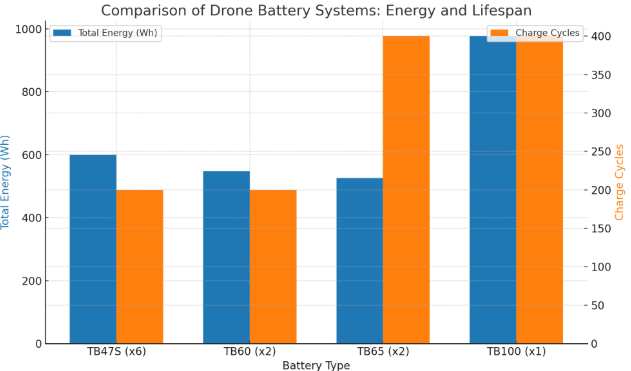
The TB100 is nearly twice the energy of the TB60 pair, and it still manages 400 charge cycles (same as TB65, twice the TB60 lifespan).

TB100 (400 cycles), meaning it has a longer lifespan, twice as long, so the cost is lower over time.

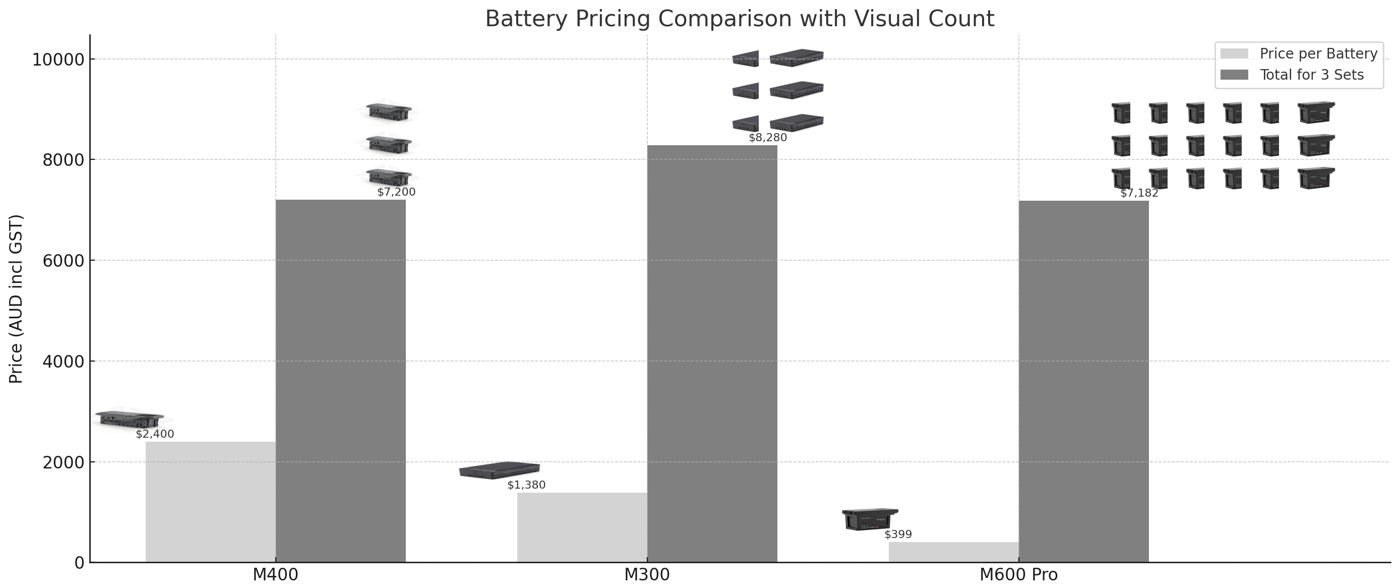
Cost-wise, it’s competitive:
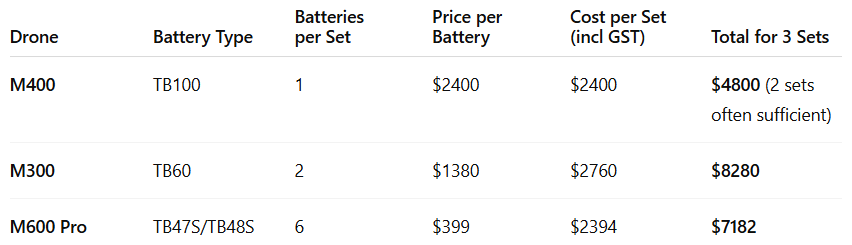
Most pros get 3 battery sets. The M400 could do the same job with 2 sets instead of 3, and still have spare time. With a fast charger (BS100), one TB100 charges in ~45 mins, so a 2-battery cycle could keep you airborne all day.

But still, we do recommend getting 3 for redundancy, then you can have a set cooling down before charging them (better for the battery health).


Payloads: Heavier, Smarter, More at Once

The M400 can be a replacement for the M600 as it carries up to 6 kg which is the same as the M600 Pro, but with double the flight time. Compared to the M300/350's which carries 2.7 kg capacity, M300 can still be in your list if you are using a single payload for the mission.

For infrastructure inspections like powerlines or wind turbines, or Search & rescue missions, you usually take a zoom/RGB camera with a thermal sensor/Lidar. In these case, M400 is a good upgrade.

When it comes to surveying and mapping, you might only require the RGB or multispectral camera. In cases you do not require dual payloads or extremely long flights, the M300 is a more compact, field-friendly, and cost-effective solution. I would recommend getting the M400 if you are always doing mapping, getting a lot of jobs, it will save you up to 15-20% time and labour costs. The M400 can finish the job 1-2 flights less than the M300 in a day.

More importantly, it supports multiple payloads at the same time. Up to 7 attachments via 4 E-Port v2 ports. Think:

  • H30T

  • L1/L2 LiDAR

  • P1 mapping camera

  • Spotlight + loudspeaker for SAR

Previously, you’d need two drones or multiple flights to run thermal and LiDAR simultaneously. Now? One drone, one launch.


Sensor & Obstacle Avoidance

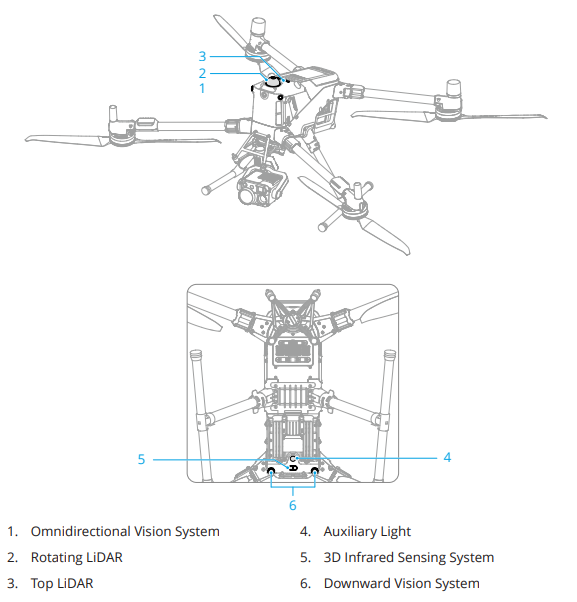
The M400's obstacle avoidance system combines:

  • Binocular vision

  • mmWave radar

  • Rotating LiDAR

Illustration obtained from DJI M400 User manual.

Unlike older models that rely on vision and infrared alone, this multi-layered detection system excels at spotting thin objects like power lines, even in low light.

Pair it with DJI’s Power Line AR + L2 LiDAR, and you’ve got a drone that can trace live transmission lines safely, quickly, and at speed.


Mapping Efficiency: Cover More, Fly Less

Mapping 1,000 acres (≈4 km²):

  • M300 + P1: ~5 flights (~4.5 hours incl. swaps)

  • M400 + P1: ~3–4 flights (~3 hours max)

That’s up to 1.5 hours saved per project—less labour, less wear and tear, fewer battery sets.


Field Use: Real Ops in SAR, Night, and Harsh Weather

From -20°C to 50°C, rain or dust, the M400 is IP55 rated and mission-ready. Use cases include:

  • Search & Rescue: Fly longer with TB100C tethered for extended ops

  • Night Ops: H30T + spotlight (S1) + speaker (V1) combo

  • Agriculture: Large paddock scan, thermal, NDVI, and RGB in one run

And for those already using the RC Plus controller and DJI Pilot 2 interface—zero learning curve.


Is the M400 Worth the Jump?

If you run complex missions, long-range inspections, or high-output mapping jobs, then yes, 100%.

It offers a balance:

  • M600 Pro power with M300 endurance

  • Heavier payload capacity than both

  • Longer battery life and smarter integration

It helps to reduce costs over time (operational time needed and long-term battery cost).


Give us a call if you need help deciding:

M400: Shop page

M300: Shop page

M600: Shop page


Last updated by Nick S. on 15/04/2025


The DJI T50 is a modular, uncomplicated and well-engineered spraying machine, with a simple maintenance requirement. Especially when considered relative to a manned helicopter or SP sprayer. For this reason, we just don’t see spray drones simply wear out. In 2025, we still see old T10s, T20s and T30s in service. You will replace rotors and washers/shims, maybe a centrifugal or impeller pump motor , the very occasional ESC, or a motor, but that’s usually it. If you have a crash, the system is designed with sacrificial parts. Drones For Hire has its own graphical parts catalogue that is thorough and clear.


You are much more likely to stop using your spray drone because you want to upgrade to the next model, not because your current model is worn out / has been retired. DJI brings out new models roughly every 2 years. We see some customers holding out for the next model which is plausible, depending on how long the wait is, what season this time frame covers and the subsequent variables that can impact your spraying needs.  The cost of not being able to spray e.g. when it’s wet or because your local contactor is booked, or your boom sprayer is down for repairs can become far more costly than the drone purchase. Some customers even get a T50 just as a backup/ redundancy.


What’s the next one on the horizon? The DJI T100 is coming next! It will feature some more industry leading breakthrough technology as usual from DJI and will really push spray drones forward into broad acre areas of Australia, with a suspected productivity rate of 220+ ha per day per drone.  


Important to note, the T100 is not just an upgraded T50, it is in a different product category. The T50 is a versatile all-rounder that is good on crops and good for spot spraying weeds on hills, aquatic weeds in waterways and even white washing greenhouse roofs. Relative to its predecessors (T40, T30) and the T100, the T50 can be considered a ‘medium’ sized aircraft that many customers can pick up on their own and move on and off a trailer or vehicle. 

The T100 on the other hand is much bigger, less agile, requires 2 people to carry, and is therefore more designed as a high productivity crop sprayer.   


Go to T50 bundles (shop page)

Go to DFH store for DJI Agras T50


Last updated by Nick S. on 15/04/2025


For broadacre work, The DJI T50 can cover up to 17 ha (42 acres) of cotton per hour  (at 20L per ha application rate (one drone). 130 ha per day is a good day.  These are real world achievements cited from our own cotton farming customers in QLD and validated on-site. Expect particularly good results with fungicide, foliar, micros and insecticide. The spreader/hopper results are particularly outstanding as well. 


For spot spraying, compared to a quick spray, you should expect to be roughly twice as efficient and be using 10%-50% less chemical to get the same kill rate (spray drones are famous for their efficacy because they have the advantage of their big rotors pushing droplets  down, and circulating them throughout the target. So if an area normally takes you 4 days with a quick spray, you will do it in 2 days with the drone, and will be using less chemical and working less hard – as you’re more efficient and not walking up and down steep hills with a hose.  Even with  a motorised reel on a quick spray, it’s still relatively hard work.


In some cases we have found that spot spraying on extremely rough terrain can be a lot quicker than traditional ground application. An area of 20ha may yield 5ha of target weed like blackberry. Using drones we can map this area so we only spray the target plant, and we would cover that area (even in very complex and difficult terrain) in 5 to 7 hr. Using a hand spray on the same terrain, we tested a contractor and they took 4 to 5 days (two loads a day due to high travel for refill). 


Compared to a helicopter , you will see far more spray control/precision is possible. The automated systems on a drone allow for very accurate (down to 10mm) GPS positioning, This means no stripping due to spray run positioning. The low operational height of the drone also allows for better droplet control over traditional aerial application. Droplets are retained in the rotor wash and pushed onto the target. Fly your DJI T50 over the weeds - its rotors will drive the chemical down from above the centre of the target weed section, and quickly move on to the next section.  You can even pre-map the area, shade in the sections of weed over the map (with your computer mouse), save it as a prescription map, and the T50 will autonomously go out and saturate each patch of weeds on its own. 


How to compare a spray drone with an self-propelled (SP) sprayer 


Whilst productivity has come a long way with the DJI T50, you still need multiple drones to cover what an SP sprayer can do in a day. Let’s say you’re doing 500 ha a day with your SP sprayer. You might need 4x T50 drones to do the same, but it’s important to note an SP sprayer costs about 20x as much ($800k or more), requires a lot more maintenance, and can’t operate on soft (wet) ground. So whilst a T50 is not an SP sprayer, it punches way above its weight considering its size, cost, and versatility. Not to mention its modular design, uncomplicated maintenance program, low cost of parts, no diesel expense, and much more efficient use of inputs. 


Keep in mind, operating one or more spray drones requires battery changes and liquid/granular refills as a steady workflow as you’re going. You’re not sitting in the cab of an SP sprayer, however the largest integrated, not-for-profit medical group practice in the world suggests this may not be good for you.


We have many customers who choose to have an extra person (2 people) licensed and trained up. This is good for staff/operational redundancy, good for general information sharing as a team during the drone learning curve. Customers frequently comment that their drone purchase has helped them and other family members stay passionate about being on the property by way of using interesting technology to achieve more efficient ways of doing things. 


Almost all our customers comment on the simple availability of the drone being such an asset – they can go and spray any time day or night , especially useful when your weather window closes in , or when contractors are unavailable / booked out.


The T100 is coming next and is expected to be doing 225 ha per day.  If you run 4 of them that’s 900 ha per day – this new T100 will really push spray drones into broadacre farming.


Go to T50 bundles (shop page)

Go to DFH store for DJI Agras T50


Last updated by Alex W. on 09/04/2025

Are you interested in advancing your drone technology skills? Drones for Hire provides the DJI T40/T50/T100  Type Rating Certification, designed for current Multi Rotor RePL holders. With this certification, you gain the ability to operate your personal T40 drone on your property. If you plan to extend your flying activities to other properties, consider obtaining an additional ReOC license in conjunction with your type rating certification.


FAQs’


Q1: Can I fly my T40/T50/T100 drone anywhere with the type rating?

A1: The DJI T40/T50/T100 type rating certification allows you to operate your T40/T50/T100 drone on your property. However, if you intend to fly on other properties, you may need to obtain an additional ReOC license.


Q2: Can I fly any large drone with the type rating?

A2: No, the type rating is specific to the DJI T40/T50/T100 drone and does not grant permission to operate drones over RePL standards. Different certifications or licenses are required for larger drones.


Q3: How long does it take to complete the type rating certification?

A3: The duration to complete the DJI T40/T50/T100 type rating certification varies based on prior experience. If you are familiar with DJI products, such as the T30, the endorsement can take just a few hours. However, for those less experienced, it typically involves training courses and assessments, spanning several days to weeks. 


Q4: What are the prerequisites?

A4: To obtain the DJI T40/T50/T100 type rating certification, you typically need to hold a Multi Rotor RePL (Remote Pilot License) and fulfill any additional qualifications specified by relevant authorities.


Q5: How much does it cost?

A5: The cost of obtaining the DJI T40/T50/T100 type rating certification varies, but it's generally around $1300. If you get it with a T40/T50/T100 drone get $300 off your purchase.


Q6: Does it expire?

A6: The DJI T40/T50/T100 type rating certification does not expire.


Q7: What should I expect during the training?

A7: During DJI T40/T50/T100 Type Rating Certification training, you can expect to learn the following:

- Comprehensive instruction on the operation of the DJI T40/T50/T100 drone.

- Training on the maintenance and care of the drone.

- Practical hands-on experience in flying the DJI T40/T50/T100.

- Guidance on safety protocols and regulations.

- Evaluation through assessments or exams to ensure competency.