Last updated by Rachel N. on 15/07/2025
DJI T25 vs T50 vs T100

The DJI Agras T100 was released recently.

Check our Shop page for the T100!

We’ll dive into a head-to-head comparison of the T25, T50, and the new T100 to see how they stack up and help you decide which drone fits your farming needs best.

We will also have a latest video with Nick and Oscar discussing the new coming T100. Coming soon


Flight Time, Speed & Payload

When it comes to agricultural drones, efficiency isn't just about how long they can fly — it's about how much ground they can cover in each flight.

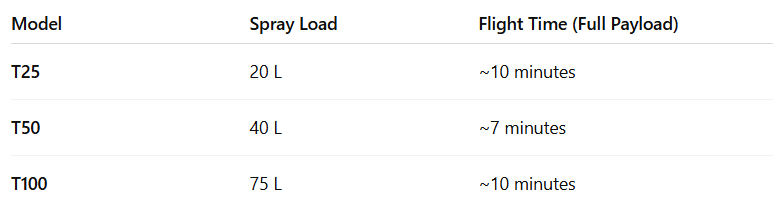
At first glance, the loaded flight times seem similar across models, but remember, the T100 is lifting nearly double the weight of a T50 and almost that of a T25 in each flight). 

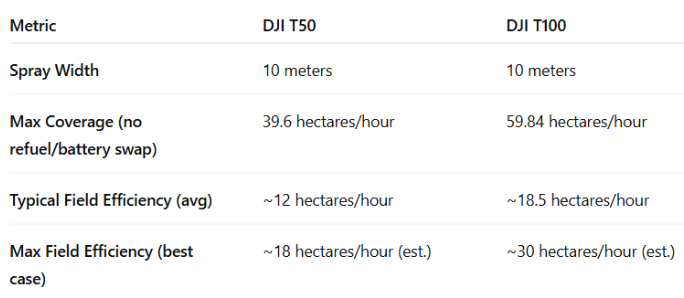
It drastically increases efficiency per sortie. From experience, our customers get to do 17-18hc per hour in maximum, with a typical operating efficiency of 12 hectares an hour. Given the T50 and T100 have a swath width of 10m, after some calculations on the expected coverage:

Fewer flights = fewer takeoffs, fewer refills, less battery swapping, and reduce the cumulative battery cycles and man-hours required. In a day of work, the T100 could complete 1–2 fewer flights than a T50 for the same area — and cut hours off a job compared to the T25. We estimate that a T100 could save around 20-25% in time and labor compared to using a T50 for the same workload. Over a long day, that might mean finishing a few hours earlier or covering extra fields – which lowers operating cost over time.

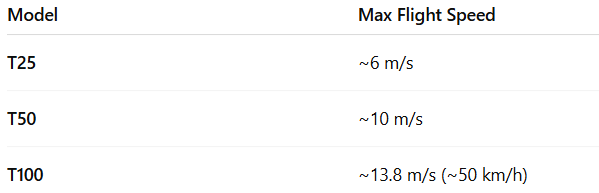
All three drones have similar recommended wind tolerance (around 6 m/s for safe spraying), but the T100’s heavier frame and more powerful motors provide extra stability in breezy conditions where a lighter drone might struggle. Faster and more stable flight translates into quicker job completion and the ability to operate in marginal conditions that might ground smaller drones.


Spraying Capacity

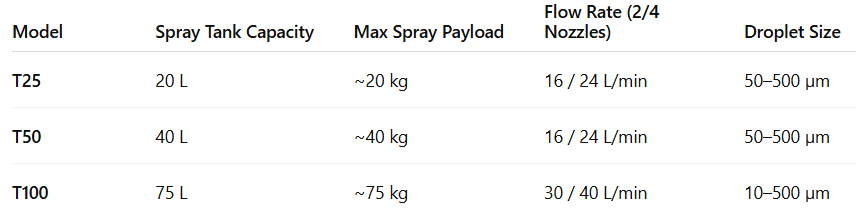
The T100 can empty its full tank in just ~2–3 minutes at max flow, allowing fast, dense applications when needed (e.g. fertilizer, frost control). You can also fine-tune spray settings for lighter, more delicate applications. It's fast and flexible.


Of course, not everyone needs that extreme capacity. If your typical jobs are small orchards or vegetable plots, a 75 L tank might be overkill (and you’re paying for capacity you won’t fully use every time). That’s why DJI still offers the T25 and T50 – they are more size-appropriate for modest needs. The T25’s 20 L tank is often enough for small farms or research plots, and its compact size makes refilling and handling very quick. The T50’s 40 L hits a sweet spot for many medium-sized farms – big enough to cut down refills significantly versus older 10–20 L drones, but not as large and heavy as the T100.


Spreading Capacity

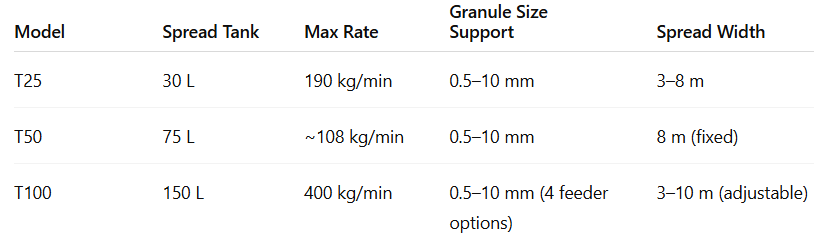
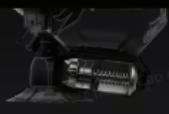
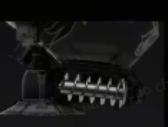
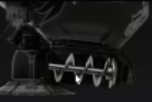
The T100’s spreader is a beast for capacity and spreading rate. It now also features an intelligent screw feeder system with 4 different attachments to handle granule sizes from fine powder up to about 10 mm without clogging. For the T50, you have no options to change the feeder. Now for the T100, you are able to swap the screw feeders, which allows you to adjust how the granule drops and changes the spread width.

By comparison, the T50’s spreader holds ~75 L and can output ~100+ kg/min, and the T25’s holds 30 L (outputting ~190 kg/min max). All can effectively spread cover crop seeds or fertilizer, but the T100 can cover vastly more area per fill and is better suited for large-scale spreading tasks.

With a faster airspeed and stronger propulsion system, it helps to push the granules better to the soil and increase efficiencies.


Heavy-Lifting Mode (T100 Only)

Unique to the T100, it has a lifting mode with a winch hook that can carry up to 85 kg of payload (via a 10 m rope). 

This isn’t a feature used for crop spraying, but it opens up other possibilities on the farm – for example, hauling supplies to remote locations, ferrying irrigation equipment, or even supporting tasks like aerial firefighting with a small water bucket. Essentially, the T100 can double as an aerial crane for rural operations. We are excited to explore possible options for this new added lifting system.

Power and Battery Efficiency: Maximizing Uptime


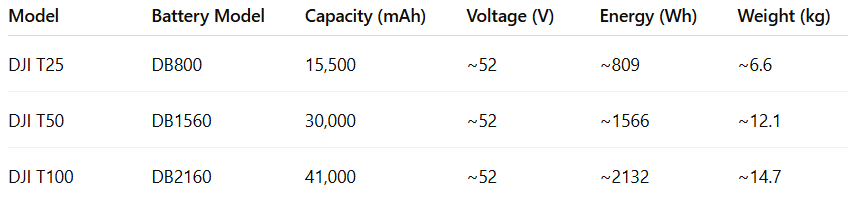
Despite the massive differences in capacity, all these battery systems are designed for rapid charging and long service life. The T100’s single battery carries roughly 1.8× the energy of the T50’s battery on its 9kW fast charger. By the time you’ve refilled the spray tank, a fresh battery can be ready to go.

Equally impressive is the battery lifespan. They are rated for up to 1,500 charge cycles with proper maintenance – far more than previous-gen drone batteries. In other words, they can be used for several seasons of heavy use before needing replacement, which significantly lowers your long-term operating costs.


Sensing and Autonomy

All three drones come with DJI’s proven Dual Active Phased Array Radar systems and binocular vision sensors. These give each drone a 360° awareness of its surroundings. In practical terms, they can detect obstacles in front of and behind the drone out to about 30 m (even in darkness or fog, since radar isn’t reliant on light). The drones will automatically brake and rise to avoid obstacles, and they also use this system for terrain following – hugging the ground contour to keep a constant height above crops, which is critical for even spray coverage. 


NOW: The Agras T100 has the onboard Lidar scanner and an augmented reality (AR) display system. The sensing range has also been increased from 30m to 60m on the T100. This helps with obstacle avoidance despite the increase in flight speed.  The spinning Lidar unit actively maps the environment in 3D with high precision. This means the T100 can pick up smaller or low-contrast obstacles that radar might miss – for example, thin power lines or bare branches. The Lidar data feeds into the new AR interface for the pilot: using the DJI Goggles or on the controller screen, you can actually see a live point-cloud visualization of the terrain and obstacles around the drone. They highlight power lines or obstacles (like an AR outline of a tree) and even project the drone’s planned path and landing point onto the display.


Remote controller

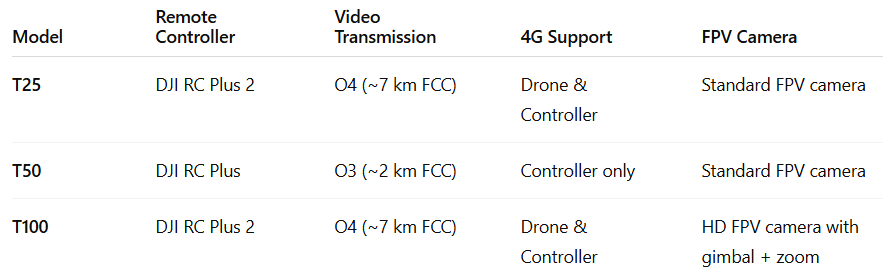
DJI has kept the user experience consistent across the T25, T50, and T100 – so if you can fly one, you can transition to the others with minimal learning curve. All three run on the DJI Agras/Pilot 2 application and support the DJI RC Plus series remote controllers (the T100 and newer T25 ship with the latest RC Plus 2, while the T50 uses the original RC Plus). The newer RC will give you better transmissions (O4).

These controllers feature a bright 7-inch screen, are weather-resistant, and have customizable buttons – perfect for outdoor use with gloves on, etc. The interface for mission planning is the same: you can draw or import field boundaries, set your spray parameters (like dosage per hectare, flight height, overlap, etc.), and the app will generate an efficient flight path automatically. One-tap takeoff and autonomous mission execution are standard on all.


Physical handling and transport
  • Agras T25: This is the smallest and lightest, weighing about 32–33 kg with battery. It has a compact folding design that one person can carry and deploy fairly easily (it’s about the size of a large suitcase when folded). If your operations involve moving the drone between many small fields, the T25’s portability is a big plus. You can throw it in the back of a utility vehicle or pickup and set it up in minutes by yourself.

  • Agras T50: With a takeoff weight around 52 kg (battery in), the T50 is heftier. It also folds, but you will typically use two people to lift and carry it safely, especially with a full tank. It’s still quite portable for its capacity – fitting in a ute/trailer and deployable by a small team in the field. Many consider the T50 the largest size that’s comfortably handled without specialized equipment. It strikes a balance between size and convenience.

  • Agras T100: This drone is massive – roughly 73 kg with battery and empty tank. It does have folding arms to reduce its volume for transport, but make no mistake, you’ll likely need a pickup truck or trailer dedicated to hauling it, and might require two people (if not some lifting tools) to move it around. Field deployment of the T100 might involve ramps or dollies to roll it out if it’s loaded. The extra logistics are something to plan for if you go with the T100 – it’s a powerhouse, but not as grab-and-go as a T25.

Another operational aspect is support and ecosystem. All these Agras drones tie into the DJI SmartFarm platform. This means you can log your flights, generate spray reports, and even use cloud-based tools for crop management. If you’re an agronomist or large farm manager, the data captured (spray volume, area covered, flight maps) can be invaluable for your records. The T100 being the newest also integrates with any upcoming DJI farm AI features (for example, spotting crop health issues via its camera, or connecting with DJI Base Stations for centimeter-level positioning). But even the T25 and T50 benefit from this ecosystem approach – they’re not isolated gadgets, they’re part of a larger smart farming toolkit.


Which Drone Should You Choose?


From our experience, many users start with what fits their current needs (maybe a T25 for a hobby farm or a T50 for a business). If you’re on the fence, consider your 2-3 year outlook: Are you taking on bigger projects or expanding your farm acreage? If so, opting for the larger model might save you from having to upgrade again so soon. On the other hand, if your work volume remains modest, the smaller models will serve you well without extra complexity.

Aside from increase in spraying and spreading efficiency, the new lifting features and safety systems is also something nice to consider as it adds a whole new purpose to the T100.

Lastly, consider redundancy and fleet composition – some large operators use multiple T50s simultaneously instead of one T100, for example, to have a backup and flexibility of splitting up for different fields. There isn’t a one-size-fits-all answer, but the good news is all three Agras drones carry DJI’s hallmark reliability and support. No matter which you choose, you’re getting a high-quality aircraft that has been tested and proven in real farming conditions worldwide.


Still not sure which drone is the perfect fit for your needs? Give us a call – we’re happy to talk through your requirements, budget, and expectations to help you make the right choice. We’ve worked with operators using all of these models and can offer insights into what will serve you best. When you’re ready, we can also provide training (Setup, RePL, Type ratings etc) and support to get you flying confidently.

DJI Agras T100: Shop page
DJI Agras T50: Shop page
DJI Agras T25: Shop page


View T100 bundles for sale - with option to reserve a kit from our first shipment

View 30 min first impressions video below


Last updated by Nick S. on 17/04/2025


Oscar (DFH head of Agriculture) with a customer Dave - getting his repaired T40 back home ready for work again

Oscar (DFH head of Agriculture) with a customer Dave - getting his repaired T40 back home ready for work again.


Last updated by Nick S. on 15/04/2025


1. Unmatched preparedness and willingness to support


Drones For Hire is an authorised DJI Agriculture Service Centre (DJI ASC).  This is because of our ag drone knowledge accumulation, service centre capabilities (repairs, demonstrations, training) and support network of technicians. We have multiple staff certified as official DJI Academy Certified Agras Instructors & DJI Certified Agras Repair Technicians. These staff had to pass exams and do complete disassembly and reassembly videos to show their knowledge is real.  Drones For Hire began selling the DJI MG-1P spray drone and has sold more DJI Ag. drones than any other dealer in Australia. We were doing demos for the T30 which had the older pressure (Teejet nozzles) back in 2022/3 (3-min video), T40 demo, and T50 demo . We support customers with a mature library of tech support videos such as this 5-min spreader calibration video tutorial. Here is a 2-min stockman video about the benefits of a regular sized drone (M3E) for scouting stock yards, monitoring feral pigs and even mustering.    


2. A setup and training day included at no cost


Spray drone purchasers receive a full day with a Drones For Hire technician for equipment set up and training. Face to face on your property. Drones For Hire has 2-3 technicians in each state, who typically own and use DJI spray drones, and mapping drones and related gear. We can’t underestimate how important this is and how often customers thank us for it. Because it means the technician has relevant knowledge and context as to how to best apply the technology to the kind of country you have on your property and your spraying/spreading goals. 


3. Mapping session included at no cost


A complimentary M3M/M4E (Mavic 3 Multispectral or Matrice 4 Enterprise) mapping flight to map the first 10 ha section of your property, as part of your setup day. Note this can be changed by request to e.g. demonstrate the Matrice 4 Thermal drone (for e.g. spotting feral pigs, counting cows, checking water levels in a cotton field).


4. Spray drone jobs subscription credit included at no cost


Credit for receiving spray drone job inquiries from our job inquiries marketplace (55,000 inquiries processed since 2013 – Australia’s largest and longest running drone job marketplace). 

Very handy if you wish to use your spray drone as a commercial business or just to pick up the odd local job.


5. Official AU stock that has a warranty and is insurable 


Drones For Hire is not interested in black market / grey market / illegal imports. These units are geo-locked by the OEM meaning they will only take off in a specific country / region of the world. Additionally, there is no local AU warranty, and the owners’ insurance policy will be void when they make a claim since the SN Serial Number will not pass the OEM reference check. Above all, these units are usually very poorly supported if at all, and arranged by short sighted, transient suppliers. 


Drones For Hire stock is legitimate and correct for the AU region and backed with an official DJI warranty. We have a good and long standing relationship with the leaders of DJI Agriculture, and local DJI staff in Australia.  


6. A commitment to innovation and local manufacturing 


Drones For Hire manufactures our own aluminium enclosures for spray drones (2-min video)


Drones For Hire also makes our own Batch Master chemical mixing stations, Fast Mover T50 transport kits, Fast-fill caps, RTK Hard Cases and various other items. 


Culturally, Our goal is to be the most farmer-centric ag. drone business in Australia and to grow fast by investing in our ‘support is sales’ mantra, and the mechanisms that enable it. 


7. Ag drone spares ready to ship


Drones For Hire recognises the urgency when a farming machine is out of action – often it happens at the worst time and can lead to yield and other losses. Our customers are always juggling different priorities and changing weather systems , varying prices for their crops/ beef/ wool etc.  

For this reason, Drones For Hire has pre-ordered and has in supply a large number of ag drone spares that we can ship very fast via our Toll Priority partnership. In all cases, we try our best to quickly understand the situation, identify the parts requirement, ship without delay and arrange help as required.


8. $1000.0 spares kit include at no cost 


We also include a $1000.0 spares kit for free with all our T50 bundles. The kit contents are carefully considered by our technicians and are updated when needed to give you the best chance of continuing to spray when a consumable part needs replacing.  


9. A solid presence in the Australian drone industry 


Drones For Hire has been operating for more than 10 years, and operates the largest and longest running drone jobs marketplace, having processed more than 55,000 drone jobs. Drones For Hire also sells $M of drone hardware each year and has a large dry-hire drone rental fleet. 


 10. A full workshop dedicated to repairs, modifications


Drones For Hire has a workshop for all warranty and non-warranty repairs. It consists of the equipment necessary to support our clients and keep their gear running such as a large working area, 100 ha for flight testing and training, substantial tools, winches, generators, vehicles, trailers, mixing/batching tanks, granular bins and a mapping training area/media area. 

Feel free to reach out and ask about the suitability of a T50 for your own property or for your contract spraying business:  [email protected] or 1300 029 829.


Go to T50 bundles (shop page)

Go to DFH store for DJI Agras T50


Last updated by Nick S. on 15/04/2025


Whatever your final T50 shopping list includes: always consider the long term and Total Cost of Ownership (TCO) on your DJI Agras 50.


If your T50 is out of action because you can’t figure out how to do something specific or because it needs parts/repairs, and you can’t get support, consider the cost of losing part of your crop or losing control of your weeds. And for contract sprayers , the cost of losing a contract and losing your local area reputation as a dependable service provider. 


I. Choose a supplier that is renowned for support and look for evidence that they can. 


The temptation is to focus on the initial purchase price – we all do it. After all, that’s the figure that’s most visible and often the first number discussed. 


Another often-overlooked component of the TCO is the cost of poor knowledge. The DJI Agras T50 is a powerful tool, but like any sophisticated technology, it requires proper training and knowledge from a good dealer , to maximize its potential. We find that just some small tips can go a long way, even basic stuff, for example explaining how Manual+ mode (in the controller) can be far more effective than regular manual mode. It is also a big advantage so not only have a drone expert teaching you the system, but also someone that understands agriculture and contracting applications. 


The cost of poor knowledge / inadequate supplier training isn’t just about operating inefficiencies—it’s about missed opportunities for improving crop health, maximizing productivity, and lowering input costs. It’s essential to invest not only in the drone but also in comprehensive training and support to ensure that the equipment is used to its fullest potential. Knowledge gaps could lead to higher operational costs, poor performance, and ultimately, reduced returns on investment. DJI T50s are very well thought out with useful flight modes and settings for different mission types  - use them to your advantage. 


II. Choose a supplier that is invested in the future


Some more DJI T50 sellers have started to pop up, many of them single operators with an ABN, a spray drone, and ute. Consider these sellers’ capacity to support customers and willingness to stay the course when things get complicated or busy.  


$34K (ex GST) isn’t much for an agricultural machine that is as capable and versatile as a DJI T50. With the right approach to this technology you will see that back in under 6 months, and many times over , in a 2-3 year period , especially when you have critical spraying /spreading to do .Just  make sure you go in to it the right way;


  • Get good advice for your initial setup (gear list that matches your needs), 
  • Get training that is specific to your spraying priorities , and ideally bring in a 2nd person (son, contractor, farm hand) for redundancy and help along the way.  
  • Go with a reputable supplier who has the means to arrange good support at short notice.


Go to T50 bundles (shop page)
Go to DFH store for DJI Agras T50


Last updated by Nick S. on 15/04/2025


The T50 , on paper, has the technology in the aircraft and RC ,  to be able to fly a range of 15 kms or more, due to its internationally revered Ocusync transmission system. The caveat is, here in Australia , it needs to comply to the CE compliance standard, as such it is capped at 2km. Similarly the US has the FCC standard. However, this doesn’t actually change anything because DJIs system (Ocusync) is far ahead of any other,  more importantly; when you're operating a spray drone you don’t really want to be more than about 1 km from it anyway, for 2 reasons:


  • You want to minimise the time the done is flying but not spraying/spreading. The trip out (ferrying time) to the mission start point from the home (Refill) point is called ‘connection routing’ in the RC menu. The longer it is, the more battery you are using up before the drone even starts spraying. 

  • The T50, fully opened out, is roughly 3 x 3m in size (280L × 308W×82H cm) with the arms and propellers unfolded, and weighs 103 kg with a full load of granular onboard (hopper full). Most operators don’t feel comfortable piloting it from far away and it should always be within line of sight anyway.  


The max speed is 36 kph (10m/sec). This limit is important when spraying because at more than this speed, the aircraft loses its ability to keep the droplets contained within the vortex bubble; video example – the Drones For Hire team spraying on rice in VIC.  This is important for getting the droplets down into the crop/pasture correctly. This is one of the absolute key advantages of a DJI T50 spray drone above a boom sprayer.  Remember you're not just getting a flying boom, you're getting a carefully designed spraying system with propellers and spraying system designed and positioned for optimum spraying results.  


The T50 spreader can take 50 kg of granular (seeds, fert, baits etc), and the liquid tank can hold 40L of spray liquid.


Go to T50 bundles (shop page)
Go to DFH store for DJI Agras T50


Last updated by Nick S. on 15/04/2025


To fly a T50 on your own property


The rules were relaxed somewhat in 2024. To fly it on your own property only requires a ‘standard’ drone licence , this is called an RePL ( Remote Pilot License) which can be done in 3 days; 2 days from home doing online theory, and 1 day  in a park flying (practical). The RePL costs about $1100.0-1300.0 depending on which training school you choose. 


To fly a T50 on someone else's property requires 2 additional things:


  1. A T50 Type Rating (also called ‘Endorsement’). This typically involves flying your T50 with a assessor standing next to you for about 2 hours. The assessor is basically looking to see if you can operate this relatively large drone (T50) safely - i.e. flying certain maneuvers and checking the environment before take off (nearby powerlines, animals and closeness of regional aerodromes). They might also ask about some basic aircraft specs ( e.g. max wind speed it should fly in, battery capacity) amongst other things. Cost is $890.0 at the time of writing.   

  2. A CASA ReOC. A Remotely Piloted Aircraft Operator’s Certificate (ReOC) is something you need that basically tells CASA you have your knowledge and procedures in palace to be able to fly your T50 safely in unfamiliar properties/environments such as a new clients property. The process involves learning, preparing a response to a scenario you will be given , and then doing a phone interview to see if you pass. An example scenario may be something like: “Fred Smith has asked you to spray his 100 ha canola plantation at map location X. You may notice this location has a nearby public footpath, is close to a regional aerodrome, and a local helicopter company performs periodic powerline checks nearby.  You will need to factor in how to manage these risks, amongst various other considerations, in your scenario response. Cost is about $1,890.0 at the time of writing.  


Interested to see who already has a CASA ReOC? Remember a ReOC is a requirement to operate a T50 on someone else's property as a contract spray business. Go to CASA list of ReOC holders.   


Go to T50 bundles (shop page)
Go to DFH store for DJI Agras T50


Last updated by Nick S. on 15/04/2025


The DJI T50 is a modular, uncomplicated and well-engineered spraying machine, with a simple maintenance requirement. Especially when considered relative to a manned helicopter or SP sprayer. For this reason, we just don’t see spray drones simply wear out. In 2025, we still see old T10s, T20s and T30s in service. You will replace rotors and washers/shims, maybe a centrifugal or impeller pump motor , the very occasional ESC, or a motor, but that’s usually it. If you have a crash, the system is designed with sacrificial parts. Drones For Hire has its own graphical parts catalogue that is thorough and clear.


You are much more likely to stop using your spray drone because you want to upgrade to the next model, not because your current model is worn out / has been retired. DJI brings out new models roughly every 2 years. We see some customers holding out for the next model which is plausible, depending on how long the wait is, what season this time frame covers and the subsequent variables that can impact your spraying needs.  The cost of not being able to spray e.g. when it’s wet or because your local contactor is booked, or your boom sprayer is down for repairs can become far more costly than the drone purchase. Some customers even get a T50 just as a backup/ redundancy.


What’s the next one on the horizon? The DJI T100 is coming next! It will feature some more industry leading breakthrough technology as usual from DJI and will really push spray drones forward into broad acre areas of Australia, with a suspected productivity rate of 220+ ha per day per drone.  


Important to note, the T100 is not just an upgraded T50, it is in a different product category. The T50 is a versatile all-rounder that is good on crops and good for spot spraying weeds on hills, aquatic weeds in waterways and even white washing greenhouse roofs. Relative to its predecessors (T40, T30) and the T100, the T50 can be considered a ‘medium’ sized aircraft that many customers can pick up on their own and move on and off a trailer or vehicle. 

The T100 on the other hand is much bigger, less agile, requires 2 people to carry, and is therefore more designed as a high productivity crop sprayer.   


Go to T50 bundles (shop page)
Go to DFH store for DJI Agras T50


Last updated by Nick S. on 15/04/2025


A T50 costs 34,500.0 ex. GST (MSRP) for the standard 3-battery kit (aircraft, controller, charger and 3x batteries). You may choose to add a spreader (hopper for seeding, fert, baits). For a more advanced setup, add a RTK3 base station for more precision,  M4E mapping drone for large area mapping (250 ha per day), and a recommended spec laptop for map making (basically a high res and up to date version of Google maps satellite view , that can be used for automated T50 mission design. 


For broadacre spraying, a simple formula to go off is multiply the application rate x 1.8. Therefore, spraying broadacre at 20L/ha would be $36.0 per ha, 30L/ha would be $54.0 per ha, 40L/ha would be $72.0 per ha and so on. As always, contractors need to be aware of the options being offered in their local area, and their pros and cons and price accordingly. Sometimes drone contractors can charge a bit less if a local boom operator is discounting, and other times more, if it's wet or there are power lines and there is no other option. We find some contractors prefer to base their pricing on a per hour rate. This can be a good way to find out what you need to charge per Ha, but remember growers always prefer a per ha rate.


For spot spraying in pasture (weeds on undulating country, hills, gullies , fence lines, difficult country etc.), is normally $275.0 to $325.0 per hour.  While this can seem expensive to growers, a few facts should be mentioned. As discussed, a drone will cover more area quicker, use less active chemicals (sometimes up to 50%), and only spray target weeds. This means the end cost is usually less than contact hand spraying in most areas. It is also nearly always a better kill (no human error to determine rates, and the drone sits above the middle of the target which can be out of reach for a hand wand). 


Return on investment (ROI): a standard T50 3-battery kit (aircraft, controller, charger and 3x batteries) is 34,000.0 ex GST. You should see a very good return on investment as a property owner e.g. increasing your grazable land on the property, and needing less contractors. And also as a contract sprayer, typically charging at least $2200.0 per day.   


How much does the DJI T50 cost? And what do contract drone sprayers charge per hectare / acre


Go to T50 bundles (shop page)
Go to DFH store for DJI Agras T50


Last updated by Nick S. on 15/04/2025


For broadacre work, The DJI T50 can cover up to 17 ha (42 acres) of cotton per hour  (at 20L per ha application rate (one drone). 130 ha per day is a good day.  These are real world achievements cited from our own cotton farming customers in QLD and validated on-site. Expect particularly good results with fungicide, foliar, micros and insecticide. The spreader/hopper results are particularly outstanding as well. 


For spot spraying, compared to a quick spray, you should expect to be roughly twice as efficient and be using 10%-50% less chemical to get the same kill rate (spray drones are famous for their efficacy because they have the advantage of their big rotors pushing droplets  down, and circulating them throughout the target. So if an area normally takes you 4 days with a quick spray, you will do it in 2 days with the drone, and will be using less chemical and working less hard – as you’re more efficient and not walking up and down steep hills with a hose.  Even with  a motorised reel on a quick spray, it’s still relatively hard work.


In some cases we have found that spot spraying on extremely rough terrain can be a lot quicker than traditional ground application. An area of 20ha may yield 5ha of target weed like blackberry. Using drones we can map this area so we only spray the target plant, and we would cover that area (even in very complex and difficult terrain) in 5 to 7 hr. Using a hand spray on the same terrain, we tested a contractor and they took 4 to 5 days (two loads a day due to high travel for refill). 


Compared to a helicopter , you will see far more spray control/precision is possible. The automated systems on a drone allow for very accurate (down to 10mm) GPS positioning, This means no stripping due to spray run positioning. The low operational height of the drone also allows for better droplet control over traditional aerial application. Droplets are retained in the rotor wash and pushed onto the target. Fly your DJI T50 over the weeds - its rotors will drive the chemical down from above the centre of the target weed section, and quickly move on to the next section.  You can even pre-map the area, shade in the sections of weed over the map (with your computer mouse), save it as a prescription map, and the T50 will autonomously go out and saturate each patch of weeds on its own. 


How to compare a spray drone with an self-propelled (SP) sprayer 


Whilst productivity has come a long way with the DJI T50, you still need multiple drones to cover what an SP sprayer can do in a day. Let’s say you’re doing 500 ha a day with your SP sprayer. You might need 4x T50 drones to do the same, but it’s important to note an SP sprayer costs about 20x as much ($800k or more), requires a lot more maintenance, and can’t operate on soft (wet) ground. So whilst a T50 is not an SP sprayer, it punches way above its weight considering its size, cost, and versatility. Not to mention its modular design, uncomplicated maintenance program, low cost of parts, no diesel expense, and much more efficient use of inputs. 


Keep in mind, operating one or more spray drones requires battery changes and liquid/granular refills as a steady workflow as you’re going. You’re not sitting in the cab of an SP sprayer, however the largest integrated, not-for-profit medical group practice in the world suggests this may not be good for you.


We have many customers who choose to have an extra person (2 people) licensed and trained up. This is good for staff/operational redundancy, good for general information sharing as a team during the drone learning curve. Customers frequently comment that their drone purchase has helped them and other family members stay passionate about being on the property by way of using interesting technology to achieve more efficient ways of doing things. 


Almost all our customers comment on the simple availability of the drone being such an asset – they can go and spray any time day or night , especially useful when your weather window closes in , or when contractors are unavailable / booked out.


The T100 is coming next and is expected to be doing 225 ha per day.  If you run 4 of them that’s 900 ha per day – this new T100 will really push spray drones into broadacre farming.


Go to T50 bundles (shop page)
Go to DFH store for DJI Agras T50


Last updated by Nick S. on 15/04/2025


Have you ever been unable to get your trail rig over ground, because it's too wet, too rough or any other access issues? Ever wished your self propelled sprayer could push more product into the target, operate over soft/wet country, cause no compaction, need no diesel, require hardly any maintenance, and be more efficient with both chemical and water rates? 

Spray drones allow spraying in any ground condition, if there is air above - it can spray it. The rotor wash on drones also provides a mixing effect, making your chemical more effective than traditional methods. 


For graziers, ever wished you could spray your weeds more easily, accurately target only the weeds and get to the areas you could never do with a Quick Spray / spot spray unit (steep, rocky, gullies, etc)? The DJI T50 makes it easy to hit more of your weeds (e.g. blackberry, tussock, St. johns wart, lantana) and increase your grazable land. 


See Farm Futures article: “Ag drone use soars as farmers see results” , May 6, 2025.


2-min video: see the high flow rate and penetration a DJI T50 can deliver (showing with T50 Atomized Sprinkler Package ($1090.0 fitted). 


5 things our customers (growers and graziers) say they like most about the DJI T50 


  1. Availability: By having a T50 yourself, you can spray/spread anytime, day or night in a moment's notice. Taking advantage of seasonal conditions and reducing yield loss while you wait for a contractor. 


  1. Efficacy: The drones' propellers sit typically just 3-4m off the ground, pushing the droplets down and circulating them to get more liquid on-target. This increases active chemical contact to the target, allowing under leaf and stem contact. 


  1. No ground compaction or crop knock down ,meaning no yield loss & no machine wear from ground impacts. 


  1. Accuracy and precise spray control: Spray drones can get into areas you've never felt safe taking your tractor into: steep, gullies, fence lines etc. RTK operation allows for GPS positioning that is accurate to 10mm. 


  1. Chemical safety: spraying via drone allows you to stand back at a distance meaning reduced risk of chemical exposure.


Watch our 35-min full T50 demo video 


Go to T50 bundles (shop page)

Go to DFH store for DJI Agras T50